
Related Articles


When applying for a job, most people focus heavily on their resume and forget about the cover letter. In my view, this is a mistake. A resume shows your education, skills, experience, and achievements, while a cover letter gives you the opportunity to explain why you are interested in the position and why you could be a good fit for the company.
A well written cover letter does not need to be complicated or extremely long. It should be clear, professional, and connected to the job you are applying for. If you are applying for your first job, changing careers, or looking for a better opportunity, learning how to write a cover letter can help you present yourself with more confidence.
What Is a Cover Letter?
A cover letter is a short professional document that is usually sent with a resume or job application. Its purpose is to introduce you to the employer and explain your interest in a specific job.
Unlike a resume, a cover letter allows you to write in a more personal way. You can explain what attracted you to the company, mention relevant skills, and show how your experience connects with the position.
I believe a good cover letter should answer three basic questions. Who are you? Why are you interested in this job? Why should the employer consider you?
If your cover letter answers these questions clearly, you already have a strong foundation.
Start With the Right Information
Before writing your cover letter, take a few minutes to understand the job description. Read the requirements carefully and identify the skills and qualifications the employer is looking for.
For example, if the job description mentions communication, customer service, organization, and computer skills, think about your own experience with these areas. You do not need to mention every skill. Focus on the ones that are most relevant to the position.
You should also research the company. Understanding what the company does and what type of work environment it has can help you write a more personalized cover letter.
A common mistake is sending exactly the same cover letter to every employer. In my opinion, this can make your application feel generic. Even a few customized sentences can make your cover letter more relevant.
Use a Professional Opening
The beginning of your cover letter should be simple and professional. If you know the hiring manager’s name, use it.
For example:
Dear Hiring Manager,
or
Dear Ms. Ahmed,
Using a person’s name can make the letter feel more personal. However, if you cannot find the hiring manager’s name, Dear Hiring Manager is perfectly acceptable.
Avoid overly casual greetings. A cover letter is a professional document, so the opening should create a positive first impression.
Introduce Yourself Clearly
Your first paragraph should explain the position you are applying for and briefly introduce your background.
For example, you could write:
I am writing to apply for the Marketing Assistant position at your company. With a background in communication and digital marketing, I am interested in bringing my skills to a team where I can contribute and continue developing professionally.
The important thing is to get to the point. Employers may receive many applications, so there is no need to spend several sentences explaining information that is not relevant to the position.
Your introduction should make it immediately clear why you are writing.
Explain Why You Want the Job
The next part should explain why you are interested in the position. This is where you can show genuine motivation.
Instead of saying that you simply need a job, explain what attracts you to the role.
For example, if you are applying for a customer service position, you might mention that you enjoy helping people, solving problems, and communicating with customers.
If you are applying for an office position, you could discuss your interest in organization, administration, communication, and supporting a professional team.
Your goal is to show that you understand the position and have a genuine reason for applying.
Connect Your Skills to the Job
This is one of the most important parts of a cover letter.
Do not simply repeat your resume. Instead, choose two or three skills that are particularly useful for the job and explain how you have used them.
For example, instead of writing:
I have good communication skills.
You could write:
During my previous work and academic projects, I regularly communicated with different people, handled questions, and worked as part of a team. These experiences helped me become more confident and organized when communicating with others.
The second version provides context and feels more natural.
Try to focus on skills that match the employer’s requirements. Relevant skills might include communication, teamwork, organization, problem solving, customer service, leadership, research, computer skills, or time management.
Include Relevant Experience
If you have professional experience, mention the experience that is most closely related to the position.
You do not need to describe every responsibility from your previous jobs. Instead, focus on achievements, responsibilities, and experiences that demonstrate your ability to perform the new role.
For example, if you are applying for an administrative position, you could mention experience with scheduling, emails, documentation, customer communication, or organizing information.
If you have no professional experience, do not assume that you have nothing valuable to mention. Students and recent graduates can discuss internships, university projects, volunteer work, freelance work, coursework, or personal projects when they are relevant to the position.
Writing a Cover Letter With No Experience
Writing a cover letter without job experience can feel difficult, but it is completely possible.
If you are applying for your first job, focus on your skills, education, willingness to learn, and relevant experiences.
For example, you might write:
Although I am beginning my professional career, my academic projects and volunteer experience have helped me develop strong communication, organization, and teamwork skills. I am eager to apply these skills in a professional environment and learn from an experienced team.
This approach is much stronger than apologizing for having no experience.
Everyone starts somewhere. A good cover letter can help employers see your potential instead of focusing only on the fact that you are new to the workforce.
Show What You Can Offer
A strong cover letter should not only explain what you want from the company. It should also explain what you can contribute.
Think about the employer’s needs.
If the company needs someone who can communicate with customers, explain how your communication skills can help.
If they need an organized employee, mention your ability to manage tasks and meet deadlines.
If they need someone who can learn quickly, provide an example that demonstrates your adaptability.
This small change in perspective can make your cover letter much stronger.
Keep Your Writing Simple
In my experience, professional writing is often more effective when it is simple and direct.
You do not need complicated vocabulary to sound professional. Avoid using words that you would not normally use just because they sound impressive.
For example, instead of saying:
I am an exceptionally motivated individual who possesses an unparalleled ability to facilitate organizational objectives.
You can simply say:
I am a motivated person who enjoys learning, solving problems, and contributing to a team.
The second sentence sounds more natural and is easier to understand.
Avoid Repeating Your Resume
Your cover letter and resume should work together, not compete with each other.
Your resume provides detailed information about your education and work history. Your cover letter should provide context and personality.
If your resume says that you worked as a sales assistant, your cover letter could explain what you learned from that experience and how those skills relate to the new job.
This gives the employer another reason to look at your application.
End With a Strong Closing
Your final paragraph should briefly summarize your interest and express your willingness to discuss the opportunity.
For example:
I would welcome the opportunity to discuss how my skills and experience could contribute to your team. Thank you for considering my application. I look forward to hearing from you.
Keep the closing professional and confident.
You can finish with:
Sincerely,
Your Name
If you are submitting the letter electronically, make sure your name and contact information are easy to find.
Common Cover Letter Mistakes to Avoid
There are several mistakes that can weaken an otherwise good cover letter.
One common mistake is making the letter too long. A cover letter should generally be concise and focused.
Another mistake is using the same letter for every application. Employers want to see that you are genuinely interested in their specific position.
Spelling and grammar mistakes can also create a poor impression. Always proofread your cover letter before sending it.
Avoid making unsupported claims such as saying you are the best candidate. It is better to demonstrate your strengths through examples.
You should also avoid discussing salary expectations unless the employer specifically asks for them.
Finally, do not include information that is unrelated to the position. Every sentence should have a reason for being there.
Cover Letter Format
A simple cover letter format can make your application look professional.
Start with your contact information if appropriate, followed by the date and employer information.
Then include your greeting, introduction, main body, closing paragraph, and signature.
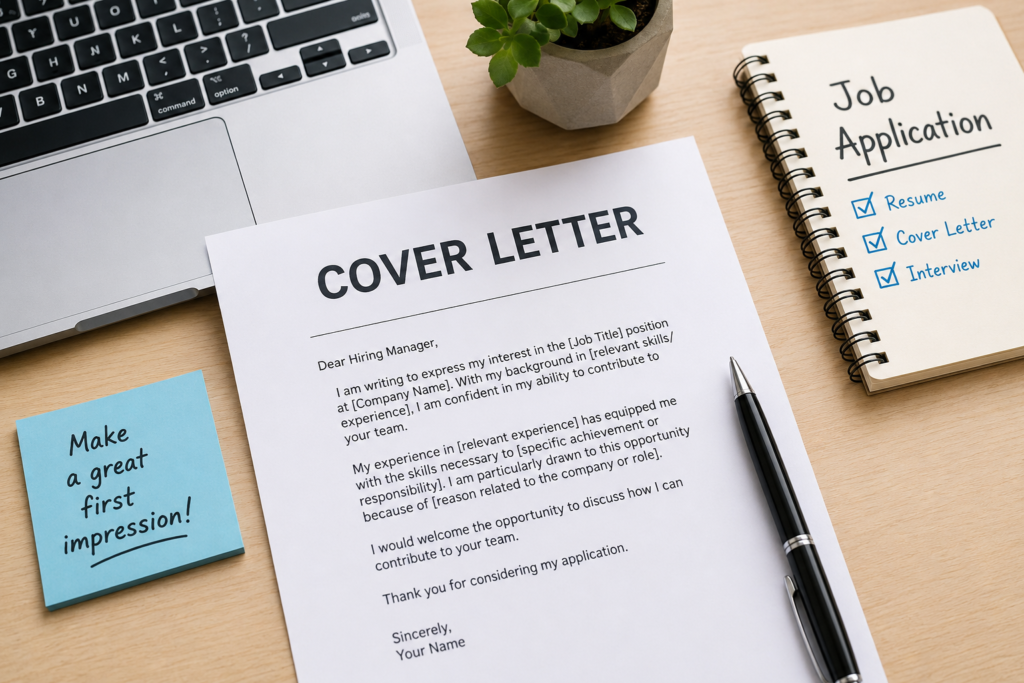
A basic structure can look like this:
Dear Hiring Manager,
I am writing to apply for the [Job Title] position at [Company Name]. I am interested in this opportunity because [reason].
My experience in [area] has helped me develop [relevant skills]. In my previous experience, I [brief example].
I believe my skills in [skill one] and [skill two] would allow me to contribute positively to your team.
Thank you for considering my application. I would welcome the opportunity to discuss the position with you.
Sincerely,
[Your Name]
This structure is simple enough for beginners while still giving you room to personalize your application.
Final Thoughts
Learning how to write a cover letter for a job is an important skill for anyone who is searching for employment. A good cover letter does not need to be perfect or filled with complicated language. What matters most is that it is relevant, honest, professional, and written specifically for the position.
From my point of view, the best cover letters sound like they were written by a real person who understands the job and genuinely wants the opportunity. Focus on what you can offer, connect your skills to the employer’s needs, and keep your writing clear.
Before submitting your application, read the cover letter one more time. Check the company name, job title, spelling, grammar, and contact information. A few extra minutes of proofreading can prevent simple mistakes.
Most importantly, do not be afraid if you do not meet every requirement listed in the job description. If you have relevant skills, a willingness to learn, and a genuine interest in the role, your cover letter can help communicate that to the employer.
A thoughtful cover letter will not guarantee an interview, but it can make your application more complete and help the hiring manager understand the person behind the resume.