
Related Articles



When I think about a resume, I do not see it as just a document that lists education, experience, and skills. I see it as a first introduction between a job seeker and an employer. Before an interview happens, your resume often has to create enough interest for the employer to want to know more about you. That is why learning how to make your resume stand out to employers can make a major difference in your job search.
In my opinion, a strong resume does not need to be complicated or filled with fancy designs. It needs to be clear, relevant, professional, and focused on the value you can bring to a company. Employers usually have limited time to review applications, so your resume should quickly communicate who you are, what you can do, and why you may be a good fit for the position.
Here are some practical ways I believe you can create a resume that gets attention for the right reasons.
Start With a Strong Professional Summary
The professional summary is one of the first sections an employer may notice. Instead of writing a general statement that could belong to anyone, I recommend creating a short summary that reflects your actual experience, strengths, and career direction.
For example, saying that you are a hardworking and motivated person is very common. Almost every applicant can say the same thing. A better approach is to explain what you specialize in and what you have achieved.
If you have experience in customer service, you could mention your years of experience, communication abilities, customer satisfaction achievements, and knowledge of relevant systems.
Your professional summary should answer a simple question: What can this person offer us?
Keep it concise and make sure it matches the position you are applying for.
Customize Your Resume for Every Job
One of the biggest mistakes I see job seekers make is sending exactly the same resume to every employer. While creating one basic resume is useful, I believe you should adjust it for each important job application.
Read the job description carefully and identify the skills, qualifications, responsibilities, and keywords the employer is looking for. Then review your resume and highlight your relevant experience.
For example, if a company is looking for someone with project management, communication, and data analysis skills, those areas should be easy to find in your resume if you genuinely have them.
This does not mean adding skills you do not possess. It means presenting your real qualifications in a way that connects directly with the employer’s needs.
A customized resume can make your application feel more relevant and intentional.
Focus on Achievements Instead of Only Duties
Your work experience section should show more than what you were expected to do. It should demonstrate what you actually accomplished.
Many resumes contain statements such as:
Responsible for managing customers.
Worked with a sales team.
Created reports.
Managed social media accounts.
These statements describe responsibilities, but they do not show the impact of your work.
Whenever possible, explain the result of your efforts. For example, you could write that you improved customer response times, increased sales, created reports that helped management make decisions, or increased social media engagement.
Numbers can be especially useful when they are accurate. Percentages, revenue figures, customer numbers, project counts, and time savings can help employers understand the scale of your contribution.
Your resume should make the employer think about what you achieved, not simply what tasks you completed.
Use Relevant Keywords
Keywords are extremely important when you want to make your resume stand out to employers. Many companies use applicant tracking systems to organize and filter applications before a recruiter reviews them.
This means your resume should naturally include relevant terms from the job description.
If the position requires communication, customer service, Microsoft Excel, project management, content writing, data analysis, or another specific skill that you genuinely possess, consider including those terms in appropriate sections of your resume.
However, I would avoid keyword stuffing. A resume should still sound natural and professional.
The goal is to make your qualifications easy for both software and human readers to understand.
Keep the Resume Easy to Read
A beautiful resume is not necessarily an effective resume. In my view, readability should always come first.
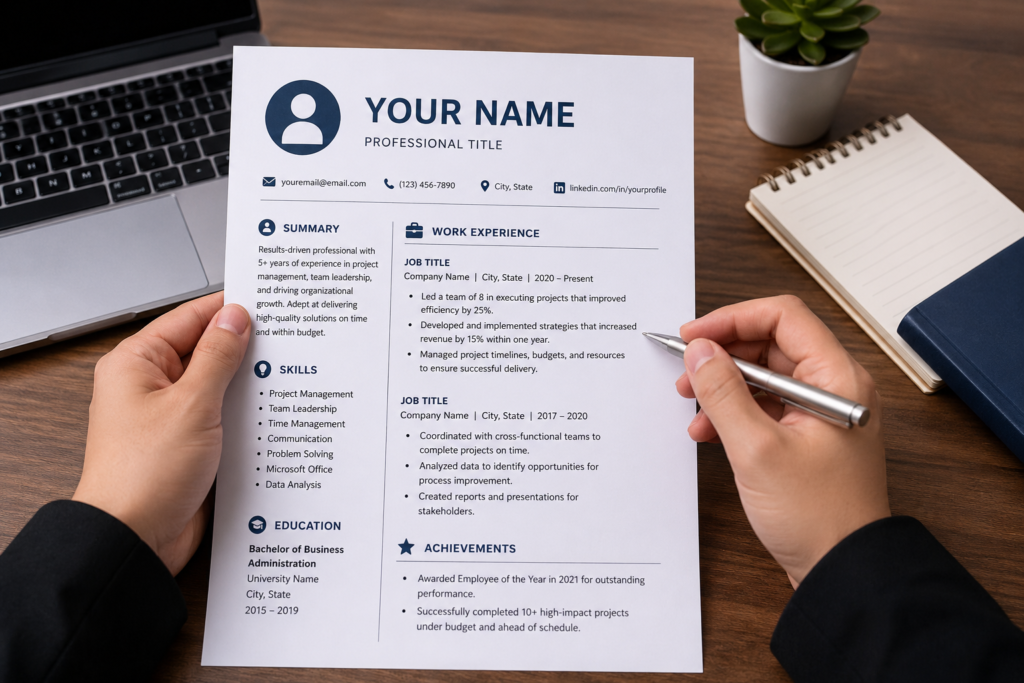
Use clear section headings, consistent formatting, readable fonts, and enough white space. Avoid filling every part of the page with text.
Your contact information should be easy to locate. Your professional summary should be clearly separated from your work experience. Education and skills should also have their own sections.
I recommend avoiding excessive colors, complicated graphics, decorative fonts, and unnecessary design elements. A clean professional layout usually works better because the reader can find important information quickly.
Remember that the purpose of design is to improve readability, not distract from your qualifications.
Choose the Right Resume Length
There is no single resume length that works for every person. Someone with limited experience may only need one page, while an experienced professional may require more space.
If you are a student, recent graduate, or entry level applicant, I would generally focus on keeping your resume concise and relevant.
If you have many years of professional experience, you may need additional space to explain important roles and achievements.
The important thing is to avoid unnecessary information. A longer resume is not automatically a stronger resume.
Every section should have a purpose.
Highlight Your Most Valuable Skills
Your skills section should reflect the requirements of the job you want.
Instead of creating a huge list of every skill you have ever learned, focus on skills that are relevant to the position.
These may include technical skills such as Excel, programming, graphic design, accounting software, data analysis, or content management systems.
You can also include valuable soft skills such as communication, teamwork, leadership, organization, problem solving, and time management when they are supported by your experience.
I believe the strongest approach is to show your skills through your work history as well. If you list leadership as a skill, your experience should provide an example of when you demonstrated leadership.
Make Your Work Experience Relevant
You do not necessarily need to describe every job you have ever had in great detail. Instead, focus on experiences that support your current career goal.
If you have several previous positions, give more attention to the roles that demonstrate relevant knowledge and achievements.
For older or less relevant positions, a shorter description may be enough.
Students and people with limited professional experience should not assume that their resume is weak. Internships, volunteer work, freelance projects, academic projects, part time jobs, and personal projects can demonstrate useful abilities when presented properly.
What matters is showing what you learned and what you accomplished.
Show Your Education Clearly
Education is an important part of many resumes, particularly for students and recent graduates.
Include your degree or qualification, institution, and relevant dates. If you have academic achievements, certifications, courses, or projects that directly relate to the position, consider including them.
For experienced professionals, education can usually be presented more briefly unless the employer specifically requires a particular qualification.
Avoid adding irrelevant details simply to make this section longer.
Proofread Your Resume Carefully
A resume with spelling mistakes and grammar problems can create a poor first impression. Even if you have excellent qualifications, careless errors may make an employer question your attention to detail.
After writing your resume, read it several times. Check spelling, grammar, punctuation, dates, job titles, company names, phone numbers, and email addresses.
I also recommend reading the resume from the perspective of an employer. Ask yourself whether the information is clear and whether your strongest qualifications are easy to find.
If possible, have another person review it as well. A fresh pair of eyes can sometimes identify mistakes that you no longer notice.
Use a Professional Email Address
Your email address may seem like a small detail, but it contributes to your overall professional image.
Use an email address that is simple and appropriate for job applications. Ideally, it should include your name or a professional variation of it.
Avoid usernames that are difficult to understand, overly casual, or connected to old personal interests.
Also make sure your phone number and other contact information are correct. A great resume is not useful if an employer cannot reach you.
Include a Link to Your Professional Profile or Portfolio
Depending on your profession, including a professional online profile or portfolio can strengthen your application.
For writers, designers, developers, marketers, photographers, and other creative professionals, a portfolio can provide evidence of your abilities.
For other professionals, a well maintained professional networking profile can support the information presented on your resume.
Only include links that are professional, relevant, and up to date. Test every link before submitting your application.
Avoid Common Resume Mistakes
There are several mistakes that can reduce the effectiveness of an otherwise good resume.
One common mistake is including too much irrelevant information. Another is using the same generic resume for every position.
Some applicants also use complicated layouts that are difficult to read. Others exaggerate their skills or include information they cannot confidently discuss during an interview.
I believe honesty is extremely important. Your resume should present your abilities in the best possible way, but everything you write should be accurate.
Do not claim expertise simply because a keyword appears in a job description.
Your resume should open the door to an interview, not create problems during the interview.
Think Like an Employer
One of the most useful things you can do is look at your resume from the employer’s perspective.
Imagine you are reviewing dozens of applications for the same position. What would make you stop and read one resume more carefully?
Usually, it will be a clear professional summary, relevant experience, measurable achievements, useful skills, and an organized presentation.
Ask yourself whether your resume immediately explains why you are suitable for the position.
If the answer is unclear, revise it.
A strong resume should not make the employer search for your best qualities. It should present them clearly.
Update Your Resume Regularly
I do not recommend waiting until you desperately need a job before updating your resume.
Whenever you complete an important project, learn a valuable skill, receive a certification, earn an award, or achieve a measurable result at work, make a note of it.
This makes future resume updates much easier.
Your career develops over time, and your resume should develop with it. An updated resume also helps you recognize how much professional progress you have made.
Final Thoughts
In my opinion, learning how to make your resume stand out to employers is less about creating a complicated document and more about communicating your value clearly.
A strong resume should be professional, relevant, easy to read, honest, and focused on achievements. Customize it for the position, use relevant keywords naturally, highlight your strongest skills, and remove information that does not support your career goal.
Most importantly, remember that your resume is not your entire career story. It is an opportunity to create enough interest for an employer to invite you to the next step.
Take time to understand what the employer needs and then show how your experience and skills can help meet those needs. When your resume communicates that message clearly, you give yourself a much stronger chance of standing out from the competition.