
Related Articles



A resume is often the first impression you make on a potential employer. Before a company invites you to an interview, the hiring manager usually looks at your resume to understand who you are, what skills you have, and what kind of experience you can bring to the job. That is why learning how to write a simple professional resume is important for both fresh graduates and experienced job seekers.
In my opinion, a good resume does not need to be complicated or filled with unnecessary information. A clean, organized, and easy to read resume can often make a stronger impression than a document with too many designs and details. The main purpose of a resume is to present your professional background clearly and help the employer quickly understand why you could be a good fit for the position.
Start With Your Contact Information
The first section of your resume should contain your basic contact information. Keep this section simple and professional. Your full name should be easy to see at the top of the page.
Include your phone number, professional email address, city and country, and a professional LinkedIn profile if you have one. Make sure every detail is correct before sending your resume to an employer.
I recommend using an email address that looks professional. An email based on your name is usually a better choice than an address containing nicknames or unnecessary numbers.
You do not need to include personal information such as your complete home address, marital status, religion, or other details that are not relevant to the job unless the employer specifically asks for them.
Write a Short Professional Summary
A professional summary is a short introduction that tells the employer what you can offer. It should usually be two or three sentences.
For example, if you are applying for a customer service position, your summary could mention your communication skills, problem solving ability, and interest in helping customers.
If you have work experience, mention your main area of expertise and a few important strengths. If you are a student or recent graduate, focus on your education, skills, projects, internships, and career goals.
A strong resume summary should be specific. Avoid writing general statements that could apply to almost anyone. Instead of saying that you are a hardworking person, explain what you can actually do and how your skills can help an employer.
Add Your Work Experience
Your work experience is one of the most important parts of a professional resume. List your most recent or current job first and then continue with your previous positions.
For every job, include the job title, company name, location, and employment dates. Under each position, describe your main responsibilities and achievements.
Try to focus on results instead of simply listing duties. For example, instead of saying that you answered customer calls, you could write that you handled customer inquiries and helped resolve common service issues.
Using clear action words can also make your resume stronger. Words such as managed, organized, created, supported, improved, assisted, prepared, and developed can help explain your responsibilities.
If you do not have professional experience, do not worry. You can include internships, volunteer work, university projects, freelance work, part time jobs, or relevant personal projects.
Highlight Your Skills
A good resume should include a clear skills section. This allows the employer to quickly see what you can do.
The skills you include should be relevant to the job you are applying for. For example, someone applying for an office assistant position might include communication, organization, Microsoft Office, data entry, scheduling, and customer service.
Someone applying for a digital marketing position might include content writing, search engine optimization, social media management, email marketing, basic analytics, and communication.
It is better to list genuine skills that you can explain during an interview. Avoid adding skills simply because they look impressive. An employer may ask you questions about anything written on your resume.
Include Your Education
Your education section should be simple and easy to understand. Include your degree or qualification, institution name, location, and completion year.
If you are a recent graduate and do not have much work experience, you can place education higher on your resume. You can also include relevant coursework, academic projects, certifications, or achievements when they support your application.
For experienced professionals, education can usually appear after work experience and skills.
Add Relevant Certifications
Certifications can help strengthen a resume, especially when they are related to the position you want.
For example, a person applying for an accounting position may include an accounting certification, while someone applying for a technology position may include relevant technical certifications.
Do not add every course you have ever taken. Choose certifications that are useful for the job and show relevant knowledge or professional development.
Keep the Resume Simple
When writing a simple professional resume, design should support the information rather than distract from it.
Use a clean font and consistent headings. Keep enough space between sections so the resume does not look crowded. Make sure your text is easy to read on both a computer screen and a printed page.
In my view, most job seekers do not need complicated graphics, multiple colors, large icons, or decorative designs. A professional resume should make it easy for a hiring manager to find your experience, skills, education, and contact information.
For many jobs, one page is enough if you are a student, recent graduate, or have limited experience. Professionals with several years of relevant experience may need two pages.
Use Job Related Keywords
Many employers use applicant tracking systems to organize and filter resumes. This makes keywords important when applying for jobs online.
Read the job description carefully and identify important skills, qualifications, tools, and job related terms. If you genuinely have those skills, use relevant keywords naturally in your resume.
For example, if a job description mentions customer service, data entry, Microsoft Excel, communication, and scheduling, and you have experience with those areas, make sure they are clearly mentioned in your resume.
Do not copy the entire job description. The goal is to create a resume that accurately represents your experience while using relevant language.
Avoid Common Resume Mistakes
Even a simple resume can lose its impact because of small mistakes. Spelling and grammar errors are among the most common problems. Always proofread your resume carefully before submitting it.
Another mistake is including too much information. Your resume should focus on information that supports your application.
Avoid using the same resume for every job. You do not necessarily need to create a completely new document each time, but you should adjust your summary, skills, and experience descriptions according to the position.
Do not exaggerate your experience. If you claim to have advanced knowledge of a particular skill, you should be prepared to demonstrate it during the interview.
Finally, make sure your contact information is current. A great resume is not useful if the employer cannot reach you.
Make Your Resume Easy to Scan
Hiring managers may receive many applications for one position. They often scan resumes quickly before deciding which candidates deserve a closer look.
This means important information should be easy to find.
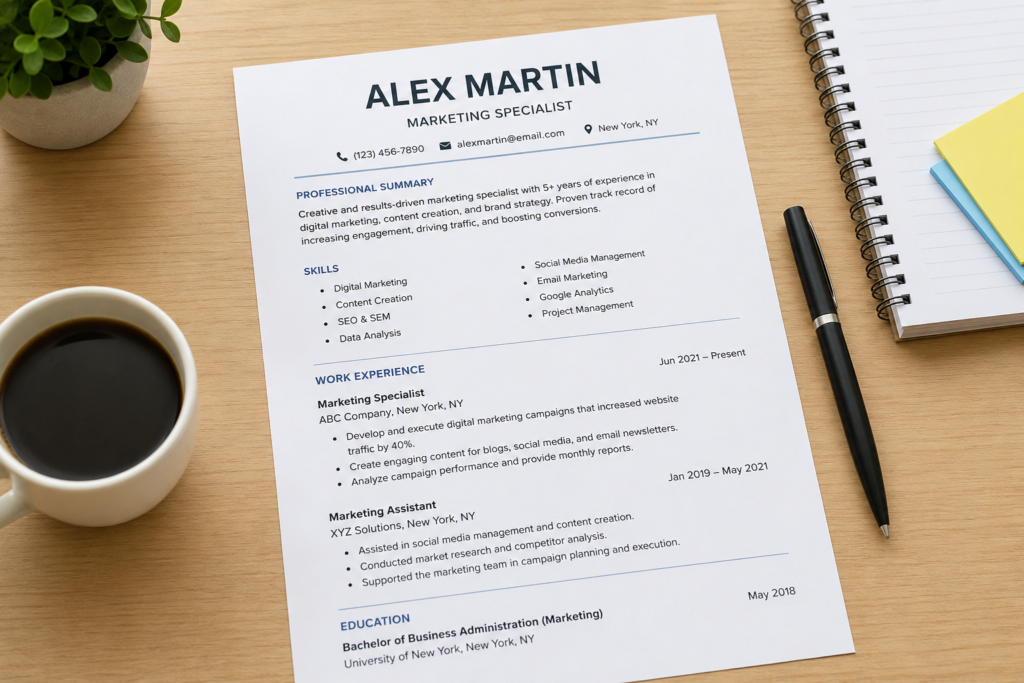
Use clear section headings such as Professional Summary, Work Experience, Skills, and Education. Keep sentences short and focus on useful information.
Avoid large blocks of text. Bullet points can make responsibilities and achievements easier to read. A clean structure can help the employer understand your background without spending too much time searching through the document.
Review Your Resume Before Sending It
Before submitting your resume, take a few minutes to review everything.
Check your name, phone number, email address, job titles, company names, employment dates, and education details. Look for spelling mistakes and inconsistent formatting.
Read the resume from the employer’s point of view. Ask yourself whether the document clearly explains what you can offer and whether the information is relevant to the job.
It can also help to ask someone you trust to read your resume. Another person may notice mistakes or unclear sentences that you missed.
Save Your Resume Professionally
When your resume is ready, save it in a professional file format. PDF is often a practical choice because it helps preserve the formatting when the document is opened on another device.
Use a simple file name that includes your name and the word Resume. This makes it easier for employers to identify your document.
For example, a file name such as Alex_Martin_Resume.pdf looks much more professional than a file called NewResumeFinalFinal2.pdf.
Final Thoughts
Learning how to write a simple professional resume does not have to be difficult. The most important thing is to present your information clearly, honestly, and professionally.
A strong resume should show your contact information, professional summary, work experience, skills, education, and relevant certifications. It should be easy to read and customized for the type of job you want.
From my point of view, the best resume is not necessarily the most colorful or creative one. It is the one that quickly tells the employer what you can do and why your background is relevant to the position.
Take your time when preparing your resume, check it carefully, and update it whenever you gain new skills or experience. A well written resume can help you make a stronger first impression and increase your chances of reaching the interview stage.
The goal is simple: keep your resume professional, relevant, honest, and easy to understand. When these four things come together, your resume becomes a much stronger tool in your job search.