
Related Articles



When I work on SEO, I do not look at every blog post as a separate piece of content. I prefer to build a clear relationship between related topics so search engines and readers can understand what a website is really about. This is where topic clusters for SEO become very useful.
A topic cluster is a content strategy where one main page covers a broad subject and several related articles cover specific subtopics. These pages are connected through internal links. When done properly, this structure can make a website easier to navigate, improve topical relevance, and create a stronger SEO foundation.
In my experience, simply publishing many articles is not enough. The real value comes from creating useful content that works together. In this article, I will explain how to build topic clusters for SEO, how to choose topics, how to create pillar content, and how internal linking connects everything.
What Is a Topic Cluster in SEO?
A topic cluster is a group of related content pieces built around one main topic.
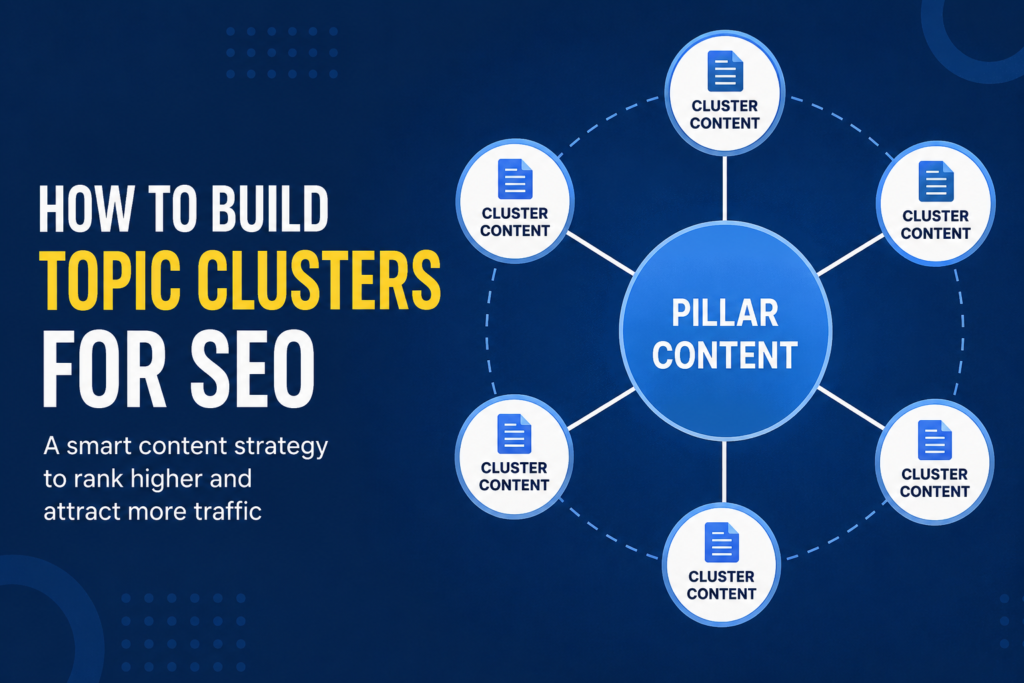
The central page is usually called pillar content. It provides a broad overview of the main subject. Around this pillar page, you create several supporting articles called cluster content. Each supporting article focuses on a specific question or subtopic.
For example, if your website is about SEO, you could create a pillar page called SEO Guide for Beginners.
Then you could create supporting articles about:
Keyword research
On page SEO
Off page SEO
Technical SEO
Internal linking
Search intent
XML sitemaps
Website speed
Mobile SEO
Each article covers a different part of SEO, but all of them are connected. The supporting articles can link back to the main pillar page, while the pillar page can link to the supporting articles.
This creates a logical content structure that benefits both users and search engines.
Why Topic Clusters Matter for SEO
One reason I like topic clusters is that they help organize content around topics instead of individual keywords.
In the past, many website owners focused heavily on finding one keyword and writing one article for it. Modern SEO requires a broader approach. Search engines are much better at understanding relationships between words, questions, topics, and concepts.
A well planned topic cluster shows that your website has useful information covering different aspects of a subject.
Topic clusters can also improve internal linking. When related pages link naturally to each other, users can discover more useful information without returning to the search results.
This can create a better user experience while helping search engines understand the structure of your website.
Step 1: Choose Your Main Topic
The first step in building a topic cluster is choosing a broad topic that is relevant to your website.
I recommend choosing a topic that meets three conditions.
First, it should be closely related to your website or business.
Second, people should actually search for information about it.
Third, the topic should be broad enough to support several useful subtopics.
For example, if your website is about digital marketing, Content Marketing could be a good main topic.
You could then cover content strategy, blog writing, content promotion, keyword research, content calendars, content optimization, and content measurement.
Avoid choosing a topic simply because it has high search volume. Relevance matters. A topic that does not fit your website will not create a useful content strategy.
Step 2: Find Related Subtopics
After selecting your main topic, start looking for related questions and subtopics.
This is where keyword research becomes important.
You can use keyword research tools to discover what people search for. You can also examine Google’s search suggestions, related searches, forums, question based searches, and competitor content.
For a topic such as SEO, you might discover questions like:
What is SEO?
How does keyword research work?
What is on page SEO?
What is technical SEO?
How does internal linking help SEO?
What is search intent?
How can website speed affect SEO?
These questions can become individual cluster articles.
I find it helpful to group keywords based on search intent rather than creating a separate article for every small keyword variation.
If several keywords represent the same user need, they may belong in one comprehensive article.
Step 3: Create Strong Pillar Content
The pillar page is the center of your topic cluster, so it needs to be useful.
A pillar page should provide a complete overview of the main subject while directing readers toward more detailed articles.
For example, a pillar page about How to Learn SEO could explain the major areas of SEO and then link to detailed guides about keyword research, on page SEO, technical SEO, link building, and content optimization.
The goal is not to make the pillar page unnecessarily long. The goal is to make it comprehensive enough to answer the main question and guide readers toward deeper information.
I believe quality is more important than word count. A 2,000 word article that clearly solves a problem can be more valuable than a 5,000 word article filled with unnecessary information.
Step 4: Create Supporting Cluster Content
Once your pillar page is ready, create supporting articles around specific subtopics.
Each cluster article should have its own purpose.
For example, if your pillar topic is Website SEO, one supporting article could target How to Improve Website Loading Speed.
Another could focus on How Internal Linking Helps SEO.
Another could explain What Is Technical SEO?
These articles should provide detailed answers instead of repeating the same information from the pillar page.
This is important because topic clusters work best when every page adds something useful.
Step 5: Use Internal Links Strategically
Internal linking is one of the most important parts of topic clusters for SEO.
Your pages should be connected naturally.
The pillar page should link to relevant cluster articles. Cluster articles should link back to the pillar page where appropriate. Related cluster articles can also link to each other when the connection is useful.
For example, an article about keyword research could link to an article about search intent. An article about technical SEO could link to website speed. An article about internal linking could link back to your main SEO guide.
Do not add internal links simply to increase the number of links. Every link should help the reader find something relevant.
I prefer using descriptive anchor text because it gives readers a clear idea of what they will find after clicking.
Step 6: Match Content With Search Intent
Search intent is another major part of a successful topic cluster.
Before writing an article, ask yourself what the searcher actually wants.
Someone searching what is technical SEO probably wants an explanation.
Someone searching how to improve technical SEO wants practical instructions.
Someone searching best SEO tools may be comparing different options.
The content should match that intent.
If your article does not answer the actual reason behind the search, even a well optimized page may struggle to perform.
Step 7: Avoid Keyword Cannibalization
When building topic clusters, be careful not to create multiple pages targeting exactly the same search intent.
Keyword cannibalization can happen when several pages on your website compete for similar queries.
For example, creating separate articles titled:
What Is Keyword Research?
Keyword Research Guide
Keyword Research for SEO
How to Do Keyword Research
could create unnecessary overlap if all four articles provide nearly identical information.
Instead, consider whether these topics should be combined into one strong resource or divided into genuinely different search intents.
A good topic cluster should have clear boundaries between its pages.
Step 8: Keep Your Content Updated
Creating a topic cluster is not a one time task.
Search trends change. Information becomes outdated. New questions appear. Your older articles may also become less useful over time.
I recommend reviewing important cluster content regularly.
Check whether statistics are still accurate, links still work, examples are relevant, and information reflects current SEO practices.
You can also add links to newer cluster articles from older pages.
This keeps the entire topic cluster connected as your website grows.
Step 9: Measure Your Topic Cluster Performance
After publishing your topic cluster, monitor its performance.
Look at organic traffic, search impressions, clicks, rankings, engagement, and conversions where relevant.
Do not judge the entire strategy based on one article.
Sometimes one cluster article becomes the main traffic source while another brings fewer visitors but attracts highly valuable users.
I also recommend checking whether your internal links are helping users discover more pages.
If a cluster has many articles but they are poorly connected, the structure may need improvement.
Common Topic Cluster Mistakes
One common mistake is creating too many articles without a clear relationship between them.
Another mistake is writing thin supporting articles simply to target more keywords.
I also see websites create a pillar page and then forget to connect it with supporting content.
Another problem is excessive internal linking. More links do not automatically mean better SEO. Links should be relevant and useful.
Finally, some website owners focus entirely on keywords and forget about readers. SEO should support good content, not replace it.
A Simple Topic Cluster Example
Let us say your main topic is Content Marketing.
Your pillar page could be:
Complete Guide to Content Marketing
Your cluster content could include:
How to Create a Content Strategy
How to Build a Content Calendar
How to Write SEO Friendly Blog Posts
How to Find Content Ideas
How to Promote Blog Content
How to Measure Content Marketing Results
These pages can be connected through relevant internal links.
Someone reading about content ideas may want to learn about content strategy. Someone reading about content promotion may want to learn how to measure results.
This creates a natural journey through your website.
Final Thoughts
In my opinion, topic clusters for SEO are one of the most practical ways to organize a growing website. Instead of publishing random articles, you create a connected library of useful information.
The process is simple. Choose a relevant broad topic, create a strong pillar page, identify useful subtopics, publish detailed cluster content, and connect everything with strategic internal links.
The most important thing is to focus on usefulness. Do not create pages just because a keyword has search volume. Create pages because they answer real questions and help readers move naturally from one topic to another.
When your content is organized around clear topics and supported by strong internal linking, your website becomes easier for users to explore and easier for search engines to understand.
That is the real purpose of building topic clusters for SEO. It is not just about creating more content. It is about creating better connected content that provides genuine value.