
Related Articles



Staying productive during the workday is something I believe depends more on how we manage our time, energy, and attention than on how many hours we spend working. A busy day does not always mean a productive day. Sometimes we can spend eight hours at work and still feel that we have not completed the important things.
In my experience, productivity becomes easier when we have a clear plan, reduce distractions, take care of our energy, and focus on one important task at a time. The goal is not to work continuously without rest. The real goal is to make better use of the time we already have.
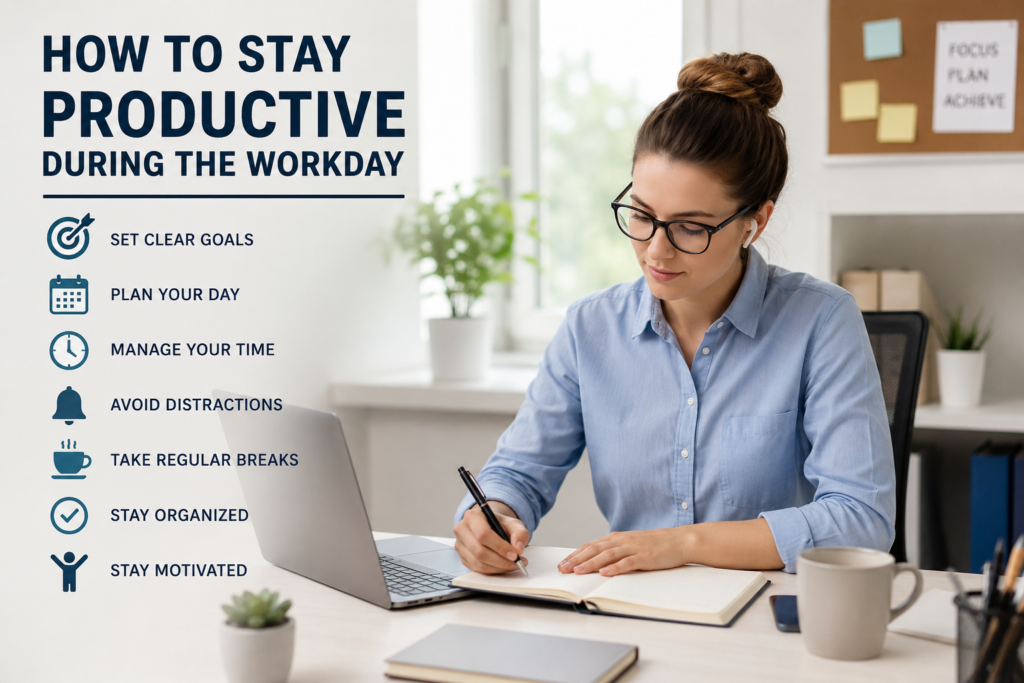
If you want to learn how to stay productive during the workday, the following practical habits can help you build a better and more organized routine.
Start Your Day With Clear Goals
One of the best ways to improve productivity is to know what you want to accomplish before the day becomes busy. I prefer to start my workday by identifying the most important tasks instead of immediately checking every notification, email, or message.
Try to choose three to five important tasks for the day. These tasks should be realistic and connected to your main responsibilities. When your goals are clear, it becomes easier to decide where your attention should go.
For example, instead of writing “work on project” on your task list, write a specific goal such as “complete the first section of the project report.” A clear task gives you a better starting point and makes progress easier to measure.
Plan Your Workday
Good planning can make a major difference in workplace productivity. I have found that spending a few minutes planning the day can save much more time later.
At the beginning of the day, look at your schedule and identify meetings, deadlines, important projects, and smaller responsibilities. Then decide when you will work on each task.
You do not need a complicated productivity system. A simple notebook, calendar, or digital task list can be enough. The important thing is to have a system that you can actually follow.
I also recommend leaving some free time in your schedule. Unexpected calls, questions, meetings, and urgent tasks can appear during the workday. A completely packed schedule can make it difficult to handle these situations without becoming stressed.
Prioritize Important Tasks
Not every task deserves the same amount of attention. Some tasks have a direct effect on your goals, while others can wait.
When I have several things to do, I try to ask myself which task will make the biggest difference if I complete it today. This simple question helps me separate important work from work that only feels urgent.
Start with high priority tasks when your energy and concentration are at their best. If you are more focused in the morning, use that time for difficult work. Save simpler tasks for periods when your energy naturally becomes lower.
Learning how to prioritize is one of the most useful productivity skills because it helps you spend your time where it matters most.
Avoid Multitasking
Many people believe that multitasking helps them finish more work, but constantly switching between tasks can make concentration harder. When I try to work on several things at the same time, I often spend more time getting back into the right mindset.
Instead, focus on one task for a specific period. Finish an important part of it before moving to something else whenever possible.
For example, if you are writing a report, try to focus only on the report instead of checking social media, answering unnecessary messages, and browsing unrelated websites at the same time.
Single tasking can make your work more organized and can help you produce better results.
Manage Workplace Distractions
Distractions are one of the biggest challenges to staying productive during the workday. Phones, social media, unnecessary notifications, background conversations, and frequent emails can easily interrupt your concentration.
I believe that the best approach is not to eliminate every distraction but to control the distractions that you can control.
Turn off unnecessary notifications while working on important tasks. Keep your phone away from your immediate workspace if it constantly attracts your attention. You can also set specific times to check email and messages instead of checking them every few minutes.
Small changes like these can create longer periods of uninterrupted focus.
Use Time Blocking
Time blocking is another useful way to improve productivity. It means giving specific periods of your day to specific types of work.
For example, you might spend the first hour working on an important project, another period answering emails, and later spend time attending meetings or completing administrative tasks.
The advantage of time blocking is that you do not have to repeatedly decide what to do next. Your schedule gives you a clear direction.
I also find it helpful to create focused work periods without unnecessary interruptions. Even 30 to 60 minutes of focused work can produce excellent results when your attention is fully on the task.
Take Regular Breaks
Being productive does not mean working without stopping. Our brains and bodies need breaks to maintain energy and concentration.
After spending a long period focusing on a difficult task, take a short break. Stand up, stretch, drink water, walk around, or simply look away from the screen.
A short break can help you return to your work with a fresher mind. I believe breaks are especially important when working on computers because staring at a screen for many hours can leave you feeling mentally tired.
The key is to make breaks intentional. A five minute break can be useful, but scrolling through social media for thirty minutes may make it harder to return to work.
Keep Your Workspace Organized
Your physical workspace can affect your ability to concentrate. A desk filled with unnecessary papers, empty cups, random objects, and unrelated materials can make work feel more stressful.
I prefer to keep only the things I need for the current task near me. Organizing your desk at the beginning or end of the workday can also make the next morning easier.
Digital organization matters too. Keep your files in clearly named folders and remove unnecessary items from your desktop. A clean digital environment can make it easier to find important documents when you need them.
Stay Hydrated and Eat Properly
Productivity is closely connected with energy. If you are tired, hungry, or dehydrated, it can become difficult to concentrate.
Keep water nearby and drink regularly throughout the day. Try to choose balanced meals that provide steady energy instead of relying entirely on heavy meals or excessive sugary snacks.
I believe that taking care of basic needs is an important part of workplace productivity. A productive routine should support your overall energy rather than constantly push you beyond your limits.
Learn to Say No When Necessary
One reason people lose productivity is that they accept too many responsibilities at the same time. Helping coworkers is important, but constantly taking on additional tasks can prevent you from completing your own priorities.
When your workload is already full, it is reasonable to explain your situation politely. You can say that you are currently working on an important deadline and ask which task should receive priority.
Saying no does not mean being unhelpful. It means understanding your limits and managing your responsibilities responsibly.
Use Meetings Wisely
Meetings can be useful, but unnecessary or poorly organized meetings can take away valuable working time.
Before joining a meeting, understand its purpose. If you are responsible for arranging a meeting, make the objective clear and keep the discussion focused.
During meetings, take short notes about decisions and action items. Afterward, update your task list so you know exactly what needs to be done.
This simple habit can prevent meetings from becoming disconnected conversations that do not lead to action.
Take Control of Your Email
Email can easily become a major distraction during the workday. If you check your inbox every few minutes, you may constantly interrupt your important work.
Instead, consider checking email at planned times. For example, you might review messages in the morning, around midday, and later in the afternoon.
Of course, some jobs require faster responses. In that situation, you can still use a system that separates urgent messages from less important ones.
The goal is to make email part of your schedule instead of allowing it to control your entire day.
Know When Your Energy Is Highest
Everyone has periods of the day when they feel more focused. Some people work best early in the morning, while others become more productive later.
Pay attention to your natural energy patterns. If you notice that you concentrate better in the morning, use those hours for creative or demanding work.
When your energy is lower, complete routine tasks such as organizing files, responding to simple messages, or preparing for the next day.
Working with your energy instead of constantly fighting it can make productivity feel much easier.
Review Your Progress Before Ending the Day
Before finishing work, take a few minutes to review what you accomplished. Look at your completed tasks and identify anything that still needs attention.
I find this habit useful because it gives me a clear picture of the day. It also helps me avoid carrying every unfinished task mentally into the evening.
Move incomplete tasks to the next day’s plan when necessary. Then prepare your priorities for tomorrow.
This small end of day routine can help you start the next morning with less confusion.
Do Not Confuse Being Busy With Being Productive
One of the most important lessons I have learned about productivity is that being busy is not the same as being productive.
You can answer dozens of emails, attend meetings, organize documents, and stay at your desk for hours without making meaningful progress on your most important goals.
Real productivity is about results. Ask yourself whether the work you are doing is helping you complete important responsibilities.
Sometimes the most productive thing you can do is stop a low value task and focus on something that has a greater impact.
Build a Routine That You Can Maintain
There is no single productivity method that works perfectly for everyone. What works for one person may not work for another.
I believe the best productivity routine is one that fits your personality, responsibilities, and energy levels. Start with a few simple habits rather than changing everything at once.
You can begin by planning your day, choosing your priorities, limiting distractions, taking regular breaks, and reviewing your progress. Once these habits become natural, you can add other techniques that suit your working style.
Final Thoughts
Learning how to stay productive during the workday is not about working every minute. It is about using your time, attention, and energy wisely. Clear goals, proper planning, focused work, fewer distractions, regular breaks, and a healthy routine can all improve workplace productivity.
From my point of view, productivity becomes much easier when we stop trying to do everything at once. Instead, we should focus on the work that matters most and give it our full attention.
A productive workday does not have to feel exhausting. With the right habits and a realistic approach, you can complete important work, stay organized, and still have enough energy left at the end of the day. The key is consistency. Small improvements repeated every day can eventually create a much more productive and balanced working life.