
Related Articles


Writing a good product description can make a big difference in online selling. When I visit an online store, I usually want to understand the product quickly. I want to know what it does, what makes it useful, what features it offers, and why I should consider buying it. A product description that is unclear, too short, or copied from another website can make the product less attractive.
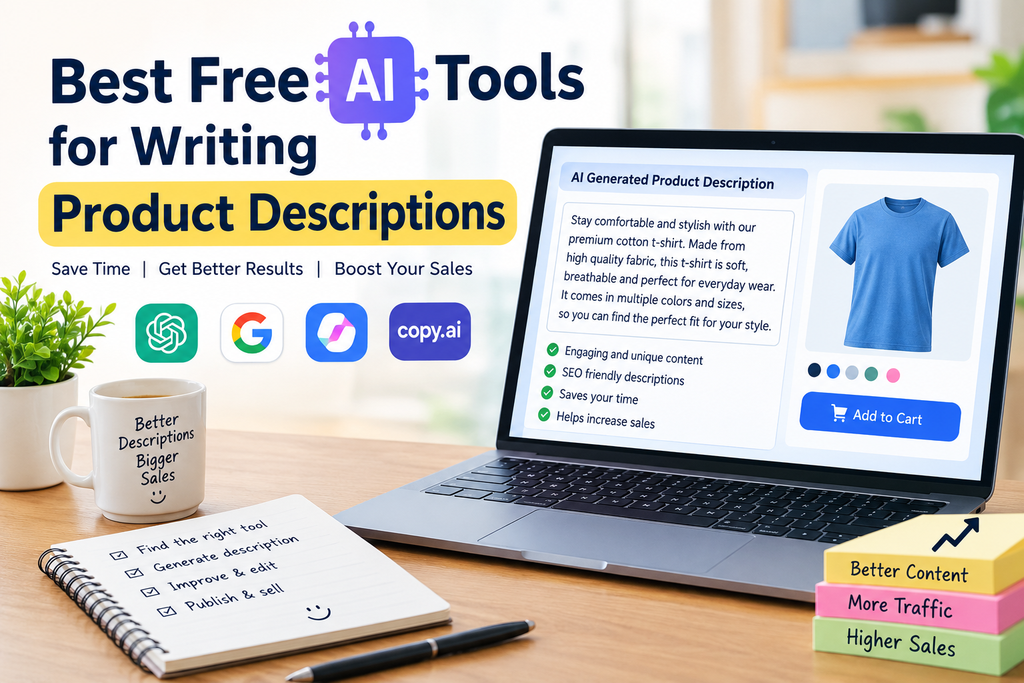
This is where free AI tools for writing product descriptions can be useful. These tools can help store owners, bloggers, ecommerce sellers, freelancers, and marketers create product descriptions faster. In my experience, AI is especially helpful when I have many products to describe and do not want to write every description completely from scratch.
The important thing is to use AI as a writing assistant rather than simply copying and publishing everything it generates. I always recommend reviewing the content, adding accurate product information, and making the final description sound natural.
What Are AI Product Description Tools?
AI product description tools are online writing tools that use artificial intelligence to create marketing content from information you provide. Usually, you enter details such as the product name, features, benefits, target audience, tone, and keywords.
The AI then creates a product description based on those details.
For example, if I sell a cotton T shirt, I might provide information about its material, available sizes, colors, comfort, and intended use. An AI writing tool can turn those basic details into a structured description that is easier for customers to read.
Many free AI writing tools can also help with headlines, bullet points, SEO content, social media copy, and marketing ideas.
Why Use Free AI Tools for Product Descriptions?
One of the biggest advantages is saving time. Writing descriptions for hundreds of products manually can take a lot of effort. AI can provide a starting point within seconds.
I also find AI useful when I know the product well but struggle to find the right words. It can suggest different ways to explain features and benefits without making the writing repetitive.
Some other benefits include:
- Faster product content creation
- Better organization of product information
- Ideas for attractive headlines
- Help with SEO keywords
- Different writing styles
- Easy rewriting and editing
- Support for ecommerce businesses
- Useful assistance for freelancers and marketers
However, free plans often have usage limits. Features can also change over time, so I recommend checking the current terms of each tool before depending on it for large scale work.
Best Free AI Tools for Writing Product Descriptions
1. ChatGPT
ChatGPT is one of the AI writing assistants I find useful for creating and improving product descriptions. It can generate descriptions from simple product information and can also rewrite existing content.
For example, I can provide the product name, main features, benefits, target customers, and keywords. I can then ask for a short ecommerce description, a detailed description, bullet points, or an SEO focused version.
Another useful feature is editing. If a description sounds too robotic, I can ask the AI to make it more natural and customer friendly.
The free availability and features of AI services can change, so users should check the current offering before planning a large content workflow.
2. Google Gemini
Google Gemini can also help with product description writing. I can use it to brainstorm ideas, rewrite descriptions, summarize product features, or create different versions of marketing copy.
One useful approach is to give Gemini detailed information instead of only providing a product name. The more accurate information I provide, the easier it is for the AI to create relevant content.
I would still check every generated description carefully because AI can misunderstand information if the original product details are incomplete.
3. Microsoft Copilot
Microsoft Copilot can be useful for people who want AI assistance while working on marketing content. It can help generate product copy, improve sentences, create variations, and organize information.
For example, I could provide a basic description such as “wireless headphones with Bluetooth connectivity, comfortable ear cushions, and a rechargeable battery.” Copilot can turn these points into a more polished product description.
I would then compare the generated copy with the actual product specifications before publishing it.
4. Copy.ai
Copy.ai is designed around marketing and business content. It can be useful when creating ecommerce copy, advertising ideas, and product descriptions.
One thing I like about specialized marketing tools is that they focus on persuasive writing. Instead of simply explaining what a product is, the generated content can help present features in a way that connects them with customer benefits.
Free access and available features may vary, so it is worth checking the current plan before using it extensively.
5. Writesonic
Writesonic is another AI writing platform that can help with marketing content. Product descriptions are one of the types of content that can benefit from AI assisted writing.
I can start with basic product information and then edit the generated text according to my store’s style. This can be especially useful when I need multiple descriptions with a consistent tone.
The most important part is giving the tool accurate information. If I provide vague details, the resulting description may also be too generic.
6. Rytr
Rytr is an AI writing assistant that can help users create different forms of marketing content. It can be useful for short product descriptions, promotional copy, and content variations.
For small businesses and beginners, a simple AI writing interface can make the content creation process easier. Instead of spending a long time thinking about the first sentence, I can use AI to create a draft and then improve it myself.
As with other tools, free usage limits and features can change.
7. QuillBot
QuillBot is particularly useful when I already have product content but want to improve or rewrite it. Rather than starting completely from zero, I can provide an existing description and ask for a clearer version.
This can be helpful when a product description is technically correct but sounds repetitive or difficult to understand.
I would not use paraphrasing tools to copy descriptions from competitors and simply change the wording. It is better to use original product information and create genuinely useful content.
How I Write Better Product Descriptions With AI
Using an AI tool is only one part of the process. The quality of the information I provide has a major effect on the final result.
First, I collect the important product information. This can include the product name, material, size, color, features, specifications, use cases, warranty information, and other relevant details.
Next, I identify the target customer. A product description for professional equipment may need a different tone than a description for children’s clothing.
Then I give the AI clear instructions.
For example, instead of writing:
“Write a product description for shoes.”
I can write:
“Write a 150 word product description for lightweight running shoes. Mention breathable material, cushioned soles, everyday comfort, available sizes, and suitability for walking and running. Use a friendly and natural tone.”
The second prompt provides much more useful information.
Focus on Benefits Instead of Only Features
One common mistake I see in product descriptions is listing features without explaining why they matter.
For example, saying that a backpack has “water resistant fabric” is useful. But explaining that the material can help protect belongings from light rain makes the benefit clearer.
AI can help transform technical features into customer friendly benefits, but I always check whether the statement is accurate.
Use SEO Keywords Naturally
If I am writing product descriptions for an online store, SEO is another important consideration.
I might use keywords such as “wireless Bluetooth headphones,” “comfortable running shoes,” or “cotton men’s T shirt.” However, I avoid repeating the same keyword unnaturally.
Search engines are designed to provide useful results to users, so I believe product descriptions should be written for people first.
The product name, important features, benefits, and relevant keywords should appear naturally throughout the content.
Keep Product Information Accurate
This is probably the most important rule when using AI for ecommerce writing.
AI can generate information that sounds convincing but is not necessarily true. If I ask an AI tool to write about a product without providing enough information, it may make assumptions.
For example, I should never allow AI to invent battery life, materials, certifications, warranty periods, dimensions, medical benefits, or performance claims.
Before publishing, I compare every important claim with the manufacturer’s information or my own verified product data.
Make the Description Sound Human
AI generated content can sometimes feel repetitive or generic. I usually edit the final version to make it sound more natural.
I remove unnecessary sentences, replace awkward phrases, and add details that are genuinely useful to customers.
A good product description should answer the customer’s questions instead of simply filling space.
Can AI Generated Product Descriptions Help SEO?
Yes, AI can assist with SEO content creation, but simply generating text does not automatically make a page rank well.
For me, good ecommerce SEO starts with useful and accurate information. The product description should clearly explain the product, include relevant search terms naturally, and provide information that helps customers make decisions.
I also pay attention to product titles, headings, image alt text, internal links, page structure, and overall website quality.
AI can help with these tasks, but it should not replace human review.
Common Mistakes to Avoid
There are several mistakes I would avoid when using free AI tools for product descriptions.
The first is publishing AI output without reading it. Even good AI tools can make errors.
The second is using exaggerated claims. Words such as “perfect,” “best,” or “guaranteed” should only be used when they are appropriate and supported.
The third is writing extremely long descriptions when customers need quick information.
The fourth is keyword stuffing. Repeating the same keyword again and again can make the description unpleasant to read.
The fifth is creating descriptions that are almost identical for every product. Each product should have information that makes it unique and useful.
Final Thoughts
In my view, free AI tools for writing product descriptions are useful assistants for ecommerce businesses, bloggers, marketers, and online sellers. They can save time, provide writing ideas, improve existing text, and help create multiple versions of product content.
Tools such as ChatGPT, Google Gemini, Microsoft Copilot, Copy.ai, Writesonic, Rytr, and QuillBot can all be useful depending on the type of content I need.
However, I would never treat AI generated text as the finished product automatically. I would provide accurate information, review the output, remove unsupported claims, add useful details, and make the final copy sound natural.
The goal should not simply be to create more product descriptions. The goal should be to create clear, useful, original, and customer focused product descriptions that help people understand what they are buying.
When AI is combined with human knowledge and careful editing, it can become a practical tool for creating better ecommerce content while saving valuable time.