
Related Articles


Frequently asked questions are an important part of a useful website. They help visitors find quick answers, understand products and services, and make better decisions before taking action. In my experience, creating FAQ content manually can take a lot of time, especially when a website has many pages and each topic needs detailed and relevant questions.
This is where AI tools for creating FAQ content can be helpful. AI can generate question ideas, organize answers, improve existing FAQs, and help website owners create content faster. However, I believe AI should be used as a writing assistant rather than a complete replacement for human research and editing.
In this article, I will discuss some of the best AI tools for creating FAQ content, how they can help, and what I look for when choosing an AI FAQ generator.
What Is FAQ Content?
FAQ stands for Frequently Asked Questions. FAQ content consists of common questions that people may have about a website, product, service, topic, or business.
For example, an online store selling shoes might include questions such as:
What sizes are available?
How long does delivery take?
Can I return my order?
How can I track my package?
Similarly, a software website might answer questions about pricing, installation, features, security, and customer support.
Good FAQ content should be simple, accurate, and directly related to the needs of visitors.
Why Use AI Tools for Creating FAQ Content?
One of the biggest advantages of AI FAQ tools is saving time. Instead of starting with a completely blank page, I can use AI to generate a list of possible questions and then select the ones that are actually useful.
AI can also help identify different ways people might ask the same question. This can be useful when creating content around a specific keyword.
Another benefit is organization. AI can group questions into topics, suggest short answers, and help improve the readability of existing FAQ sections.
However, I always recommend checking AI generated answers before publishing them. AI can sometimes provide outdated, incomplete, or incorrect information.
Best AI Tools for Creating FAQ Content
1. ChatGPT
ChatGPT is one of the most flexible AI tools for creating FAQ content. It can generate questions and answers for almost any topic when given clear instructions.
I find it particularly useful when I want to create FAQ ideas based on an article, product, service, or specific keyword.
For example, I can provide an article and ask the AI to create relevant questions based only on the information contained in that article. I can also request short answers, beginner friendly explanations, or questions organized by topic.
Another useful feature is rewriting. If an FAQ answer sounds too complicated, ChatGPT can make it easier to understand.
For SEO focused websites, I can also ask for questions that naturally relate to a target keyword. The important thing is to avoid forcing keywords into every question.
2. Google Gemini
Google Gemini can also be useful for brainstorming FAQ questions and creating initial answers. It is particularly helpful when I want to explore a topic from different angles.
I can give Gemini a topic and ask it to suggest common questions beginners may have. It can then help organize these questions into categories.
For example, an FAQ section about a travel website could include questions about planning, transportation, accommodation, costs, safety, and local activities.
As with other AI tools, I would still review the answers carefully before publishing them.
3. Claude
Claude is another AI writing assistant that can be useful for detailed FAQ content. One reason I like this type of tool for FAQ work is that it can help maintain a natural conversational style.
When creating FAQs, I prefer answers that sound like they were written for real people instead of search engines. Claude can help rewrite technical explanations into clearer language.
It can also review a large collection of questions and identify repetitive or similar topics.
This can be useful for websites with large FAQ sections where keeping the content organized is important.
4. Copy.ai
Copy.ai is designed around content creation and marketing workflows. It can be useful for businesses that need FAQ content alongside other website copy.
For example, a business might need product descriptions, landing page content, social media copy, and FAQs. Having these tasks within a broader content workflow can save time.
I would use a tool like Copy.ai when I want FAQ content that fits into a wider marketing project.
The generated content should still be reviewed to make sure claims about products, prices, policies, or services are correct.
5. Writesonic
Writesonic is another AI content platform that can assist with website content and FAQ ideas.
It can be useful when creating questions around a particular subject and developing short answers for website visitors.
For SEO content creators, AI writing platforms can also help with content planning. I would use the generated questions as a starting point rather than publishing everything automatically.
A good FAQ section should answer real customer questions, not simply contain a large number of keyword variations.
6. Jasper
Jasper is an AI writing platform that focuses heavily on marketing and business content. It can be useful for companies that want their FAQ section to match the tone of their brand.
For example, a professional software company may want clear and formal FAQ answers, while a lifestyle brand may prefer a more friendly writing style.
Consistent tone matters because FAQ pages are part of the overall customer experience.
Jasper can help create initial drafts, but human editing is still important for accuracy and originality.
How I Choose an AI FAQ Tool
When I choose an AI tool for FAQ content, I do not look only at how quickly it generates text. I also consider the quality of the questions and whether the answers actually help visitors.
The first thing I look for is relevance. An AI tool should be able to generate questions related to the exact subject rather than producing generic questions.
The second thing is accuracy. This is especially important for legal, financial, medical, technical, or product related websites. AI generated information should be checked against reliable sources.
I also consider customization. A good tool should allow me to provide instructions about audience, tone, length, and subject.
Another factor is editing. I prefer tools that make it easy to improve an existing answer rather than forcing me to create everything from the beginning.
How to Create Better FAQ Content With AI
Using an AI tool does not automatically create a good FAQ page. The quality of the instructions and research matters.
I usually start by identifying the main topic of the page. Then I think about what a visitor would actually want to know.
Next, I can ask an AI tool to generate possible questions.
After that, I remove questions that are repetitive, irrelevant, or too obvious.
The next step is reviewing the answers. I check facts, dates, prices, policies, specifications, and other information that could change.
Finally, I edit the language so that the answers sound natural.
This process gives me much better results than simply asking an AI tool to create an entire FAQ page and publishing the result without checking it.
AI FAQ Content and SEO
FAQ content can support SEO when it genuinely answers questions people are searching for.
However, I do not recommend creating FAQs simply to insert keywords. Search engines are designed to provide useful results, and readers can quickly notice when content feels unnatural.
A better approach is to create questions based on genuine user needs.
For example, instead of repeating a keyword in several questions, I might create useful questions such as:
How does this service work?
Who is this service suitable for?
How much does it cost?
How long does it take?
What should I do if I need help?
These questions can provide useful information while naturally covering important topics.
Website owners should also keep their FAQ content updated. An answer that was correct last year may not be correct today.
Benefits of Using AI for FAQ Creation
There are several reasons why I think AI tools can be valuable for FAQ content.
Faster content creation: AI can generate question ideas within seconds.
Better brainstorming: It can suggest questions I may not have considered.
Improved organization: AI can group related questions into logical sections.
Easy rewriting: Complicated answers can be converted into simpler language.
Content consistency: AI can help maintain a similar writing style throughout a large FAQ section.
Support for SEO research: AI can help brainstorm questions related to important topics and keywords.
The biggest benefit, in my opinion, is that AI reduces the amount of repetitive work. This allows me to spend more time researching information and improving the final content.
Mistakes to Avoid When Using AI for FAQs
One common mistake is publishing AI generated content without reviewing it.
Another mistake is creating too many questions. A huge FAQ page is not automatically better. Visitors usually want clear answers to their most important questions.
I also avoid making answers unnecessarily long. If a question can be answered clearly in a few sentences, there is no need to turn it into a large paragraph.
Another important point is originality. AI should help create useful content, but website owners should add their own knowledge, examples, experience, and research.
I also recommend avoiding unsupported claims. If an AI tool provides a statistic or specific fact, verify it before publishing.
Final Thoughts
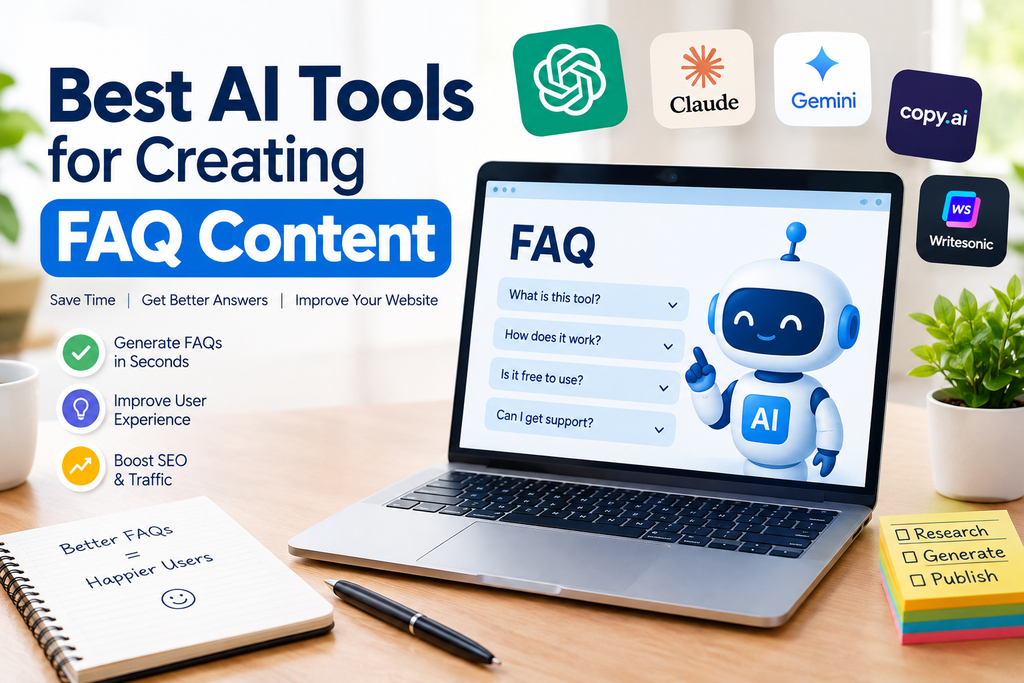
AI tools for creating FAQ content can make the content creation process much easier. Tools such as ChatGPT, Google Gemini, Claude, Copy.ai, Writesonic, and Jasper can help generate questions, create draft answers, organize information, and improve existing content.
From my point of view, the best approach is to use AI as an assistant rather than depending on it completely. I would use AI to brainstorm questions and create first drafts, then add my own knowledge and carefully verify the information.
A successful FAQ section should ultimately serve the visitor. When the questions are relevant, the answers are accurate, and the language is easy to understand, FAQ content can improve the overall website experience while also supporting a well organized SEO strategy.
The goal should not simply be to create more FAQ content. The goal should be to create useful FAQ content that answers real questions clearly and efficiently. That is where AI can become a valuable part of a modern content creation workflow.