Related Articles

When I started learning SEO, backlinks were one of the areas that confused me the most. I knew that backlinks could help a website build authority and improve its search visibility, but finding useful backlinks was not always easy. After spending time researching different SEO methods, I realized that using the best backlink tool can make the process much easier.
A backlink tool can help me discover links pointing to my website, analyze competitor backlinks, find new link opportunities, and understand the overall backlink profile of a domain. Instead of checking websites manually, I can use an SEO backlink tool to collect important information in a much shorter time.
In this article, I will explain what a backlink tool is, why backlinks matter, what features I look for in a good tool, and how I can use backlink analysis to improve my website SEO.
What Is a Backlink?
Before discussing the best backlink tool, it is important to understand what a backlink actually means.
A backlink is a link from one website to another website. For example, if another website publishes an article and links to one of my pages, that link is considered a backlink for my website.
Backlinks can be useful because they can help search engines discover pages and understand relationships between websites. A link from a relevant and trustworthy website can also bring real visitors to my website.
However, I do not think that simply collecting hundreds or thousands of backlinks is a good SEO strategy. Quality, relevance, and natural link building are much more important than creating a large number of low quality links.
Why Do I Need a Backlink Tool?
When I manage a website, it can become difficult to track every link pointing toward it. This is where a backlink checker becomes useful.
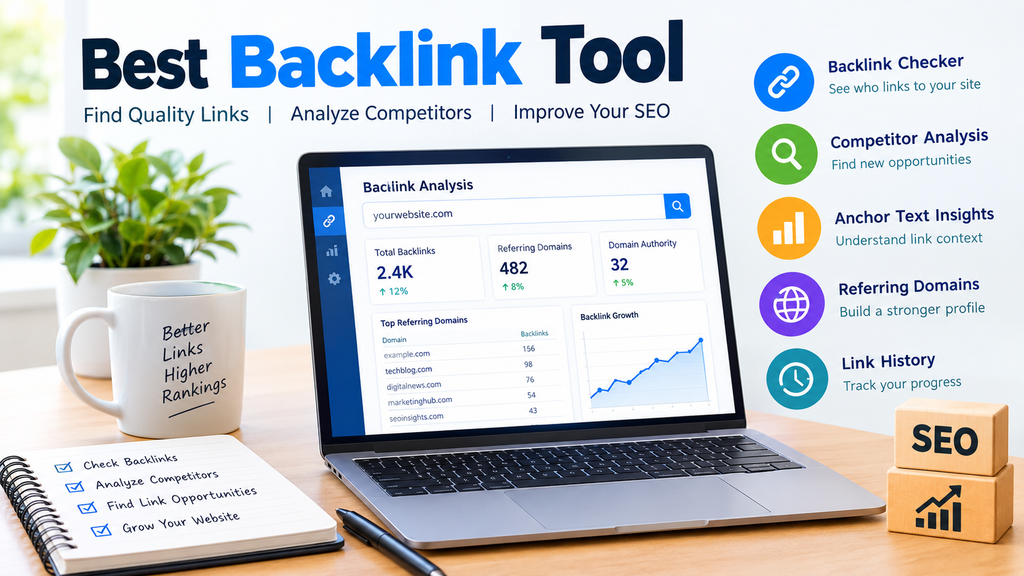
A good backlink tool can show information such as the websites linking to my domain, the pages receiving links, anchor text, link types, and sometimes additional authority metrics.
I can use this information to understand my website’s backlink profile and identify areas that may need improvement.
For example, if I notice that several websites in my industry are linking to similar resources, I can study those pages and create better content that may naturally attract links.
Features I Look for in the Best Backlink Tool
Different backlink tools provide different features. In my experience, there are several features that make a tool much more useful.
Backlink Checker
The most important feature is a reliable backlink checker. It should allow me to enter a domain or page and discover links pointing toward it.
This gives me a basic picture of my website’s backlink profile.
Competitor Backlink Analysis
Competitor research is another feature I find very useful.
If another website is ranking well for topics that I want to target, I can analyze its backlinks and learn which websites are referencing its content.
I do not copy those links blindly. Instead, I use the information to discover potential content ideas and legitimate outreach opportunities.
Anchor Text Analysis
Anchor text is the clickable text used in a backlink.
A backlink tool can help me see which words or phrases websites are using when they link to my pages. This information can help me understand how other websites describe my content.
Referring Domains
The number of backlinks alone does not tell me everything. I also want to know how many different websites are linking to my content.
A tool that shows referring domains makes it easier to understand whether my links are coming from many different websites or repeatedly from a small number of domains.
Link History
Some backlink tools allow me to monitor how my backlink profile changes over time.
I find this useful because SEO is not something I can measure properly from a single day. Tracking changes can help me understand whether my link building efforts are producing natural growth.
How I Use a Backlink Tool
My approach to backlink analysis is fairly simple.
First, I enter my website into the backlink checker. I review the domains that are linking to my pages and look for relevant websites.
Next, I check which pages are receiving the most backlinks. This can tell me what type of content is attracting attention.
After that, I look at competitor websites. I compare their link profiles with mine and search for websites that may be relevant to my own content strategy.
Finally, I use the information to improve my content and outreach strategy.
The important thing for me is not to treat the backlink tool as a shortcut for building thousands of links. I use it mainly as a research and analysis tool.
Free Backlink Tools vs Paid Backlink Tools
There are both free and paid backlink tools available.
Free backlink tools can be useful for beginners who are learning SEO or managing a small website. They often provide basic backlink information without requiring a subscription.
Paid SEO tools usually provide much larger databases and more advanced features. Depending on the platform, they may include competitor analysis, historical data, keyword research, site auditing, link monitoring, and other SEO functions.
For someone who is just starting, I would first learn how backlink analysis works before paying for an expensive subscription.
Once a website becomes larger and SEO research becomes a regular part of my work, advanced tools can become more valuable.
How to Check Backlinks Properly
When I check backlinks, I do not focus only on the total number.
I look at the quality and relevance of the linking websites. A backlink from a website related to my topic can be more meaningful than a random link from an unrelated website.
I also look at the page where the backlink appears. A contextual link inside useful content can be different from a link placed in an unrelated section.
I also pay attention to suspicious patterns. If a backlink profile contains many obviously artificial or unrelated links, I investigate them instead of assuming that every backlink is beneficial.
Backlink Tools for Competitor Research
One of the most useful applications of a backlink analysis tool is competitor research.
Suppose I have a website about digital tools. I can find websites that compete for similar search terms and analyze their backlink profiles.
I can then ask questions such as:
Which pages receive the most backlinks?
What type of content attracts links?
Which websites mention my competitors?
Are there industry publications that regularly link to similar resources?
This research can give me ideas for creating better content.
The goal is not to duplicate another website’s backlink profile. Instead, I use competitor research to understand the type of content and relationships that may contribute to visibility in my industry.
How Backlinks Can Support SEO
Backlinks are one part of a larger SEO strategy.
I would never depend on backlinks alone. A website also needs useful content, good technical SEO, a clear site structure, appropriate keywords, fast performance, and a positive user experience.
When these elements work together, backlinks can support the overall authority and discoverability of a website.
For me, this is an important point because it is easy to believe that buying or creating many backlinks will automatically make a website rank higher. SEO does not work that simply.
Avoid Low Quality Backlink Strategies
When using a backlink tool, I can sometimes discover links that I did not intentionally create.
This is why I think backlink monitoring is useful.
I should also avoid strategies that focus on creating large numbers of artificial links. Examples can include spammy link networks, irrelevant automated links, and other manipulative approaches.
Instead, I prefer focusing on useful content, genuine relationships, relevant outreach, digital PR, original research, and resources that other website owners actually want to reference.
A good backlink tool helps me identify opportunities, but the quality of my SEO strategy still depends on how I use that information.
What Makes a Backlink Valuable?
I consider several factors when evaluating a backlink.
Relevance is important because a link from a website covering a related subject makes more sense to users.
The quality of the referring website also matters. I prefer links from legitimate websites that publish useful and original content.
Context is another important factor. A link placed naturally within relevant content can provide more value to readers than a random link with no connection to the surrounding topic.
Traffic can also be useful. Even if a backlink does not dramatically affect rankings, it can still send interested visitors to my website.
My Final Thoughts on the Best Backlink Tool
In my opinion, the best backlink tool is not necessarily the one with the largest number of features. The best choice depends on what I actually need.
For basic backlink checking, a free tool may be enough. For serious SEO research, competitor analysis, backlink monitoring, and larger websites, an advanced SEO platform may provide more useful data.
I see backlink tools as research assistants rather than automatic ranking solutions. They help me understand who links to my website, where my competitors receive links, which pages attract attention, and where I may have opportunities to improve.
Most importantly, I would focus on building a website that deserves to receive backlinks naturally. Helpful content, original information, useful resources, and a good user experience can create genuine reasons for other websites to reference my pages.
If I combine those efforts with regular backlink analysis, I can make more informed SEO decisions and gradually develop a stronger backlink profile.