
Related Articles


When I first started learning SEO, I thought most of the work was about optimizing the website itself. I focused on keywords, headings, meta descriptions, content quality, page speed, and other things that happen directly on a website. Later, I learned that SEO is much bigger than what happens on your own pages. This is where off page SEO becomes important.
In simple words, off page SEO refers to the activities performed outside your website to improve its authority, reputation, visibility, and rankings in search engines. While on page SEO focuses on optimizing your website content and structure, off page SEO focuses more on how other websites and people view and mention your website.
In my opinion, off page SEO is one of the most important parts of a complete SEO strategy because a website can have excellent content, but it may still struggle to compete if nobody recognizes or recommends it.
What Is Off Page SEO?
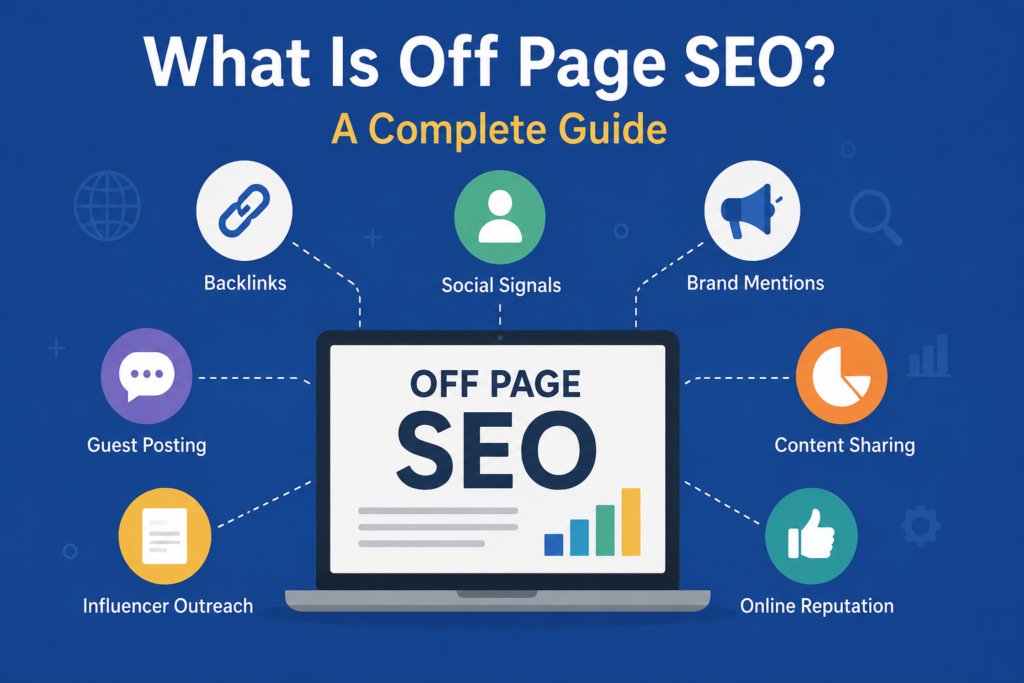
Off page SEO is the process of improving a website’s search engine presence through activities that happen outside the website. These activities can include earning backlinks, promoting content, building brand mentions, guest posting, digital PR, and developing relationships with relevant websites.
The main goal of off page SEO is to build trust and authority.
Search engines use many signals to understand whether a website deserves to rank for a particular search. When reputable websites naturally reference your content, it can help search engines understand that your website provides useful information.
For example, imagine that you publish an article about digital marketing. Another respected website discovers your article and links to it because it provides useful information. That link can send visitors to your website and may also contribute to your website’s authority.
This is one reason why backlinks remain an important topic in off page SEO.
Why Is Off Page SEO Important?
I believe off page SEO is important because search engines do not look at your website in isolation. They also consider signals from the wider web.
A website may have beautifully written articles, but if it has no reputation, no references, and very little visibility, it can be difficult to compete with established websites.
Good off page SEO can help with several areas.
First, it can help increase website authority. When relevant and trustworthy websites refer to your content, your site can gain stronger signals of credibility.
Second, off page SEO can bring referral traffic. A useful link from another website can send actual visitors who are interested in your topic.
Third, it can increase brand awareness. When people see your website mentioned across different platforms, they become more familiar with your brand.
Finally, successful off page SEO can support better search engine visibility over time.
Backlinks and Off Page SEO
Backlinks are links from another website pointing to your website. They are one of the best known elements of off page SEO.
However, I would not recommend focusing on the number of backlinks alone. In my experience, quality and relevance are much more important than simply collecting hundreds of links.
For example, one relevant backlink from a respected website in your industry can be more useful than many low quality links from unrelated websites.
A good backlink should ideally come from a website that is relevant to your topic and has a genuine audience. The link should also make sense in the context of the content.
This is why I prefer thinking about backlinks as recommendations rather than numbers. If a website owner genuinely finds your content useful and recommends it to readers, that is a much stronger approach than trying to create links simply for SEO.
Quality Matters More Than Quantity
One common mistake beginners make is believing that more backlinks automatically mean better rankings.
That is not how I approach off page SEO.
A large number of poor quality or irrelevant links may not provide meaningful value. In some situations, attempts to manipulate links can also create SEO problems.
Instead, I focus on earning links naturally by creating content worth referencing.
For example, original research, helpful guides, statistics, detailed tutorials, useful resources, and practical explanations can attract attention from other websites.
The goal should be to create something people actually want to reference.
Guest Posting
Guest posting is another popular off page SEO technique. It involves writing an article for another website and usually receiving an opportunity to mention or link to your own website where appropriate.
When done properly, guest posting can provide several benefits.
It can introduce your brand to a new audience. It can help you build relationships with other website owners. It can also generate referral traffic and potentially earn relevant backlinks.
However, I would avoid publishing low quality articles on random websites only because they offer a backlink.
The website should be relevant to your industry, the article should provide genuine value, and any link should be useful for readers.
Guest posting works best when the main purpose is helping the audience rather than simply placing a link.
Brand Mentions
Off page SEO is not only about backlinks.
Brand mentions are also useful for building online visibility. A brand mention happens when another website, publication, community, or online platform talks about your business or website.
Sometimes the mention includes a link, and sometimes it does not.
Building a recognizable brand can make your website appear more trustworthy to users. When people repeatedly encounter your brand while searching for information, they may become more likely to visit your website.
This is why I believe SEO and branding should work together instead of being treated as completely separate activities.
Social Media and Off Page SEO
Social media is often included in discussions about off page SEO, but I would not treat social media likes and followers as direct replacements for backlinks.
The bigger value of social media is content distribution and brand exposure.
When you publish a useful article, you can share it through relevant social platforms. If people find it valuable, they may share it with others, discuss it, or even discover your website through those conversations.
Social media can therefore help increase the reach of your content.
For me, the important point is not to chase social numbers just for SEO. Instead, I use social platforms as a way to reach real people and encourage natural engagement with useful content.
Digital PR
Digital PR is another powerful part of modern off page SEO.
Digital PR involves getting your brand, expertise, research, or content mentioned by online publications and other authoritative websites.
For example, if you publish original research about website traffic or online marketing trends, journalists and bloggers may find that information useful for their own articles.
These mentions can increase brand awareness, referral traffic, and potentially generate valuable backlinks.
The key is having something genuinely interesting or useful to share.
Influencer Outreach
Influencer outreach can also support off page SEO by helping your content reach an established audience.
An influencer does not necessarily have to be a celebrity. In my view, a smaller creator with a highly relevant audience can sometimes be more valuable than someone with millions of followers.
If an industry expert discovers and shares your content, you may gain new visitors and brand recognition.
The important thing is to build genuine relationships. Sending the same promotional message to hundreds of people is unlikely to produce meaningful results.
Online Reputation
Your online reputation also matters.
People often search for a brand before trusting it. They may read reviews, look at social profiles, search for discussions, and check what other websites say about the business.
A positive online reputation can improve user confidence.
This is especially important for businesses that depend on local customers or online sales.
I believe reputation management should be considered part of a broader off page SEO strategy because SEO is ultimately connected to trust. Ranking well is useful, but having a brand that people trust is even more valuable in the long term.
How to Build a Strong Off Page SEO Strategy
If I were starting a new website today, I would keep my off page SEO strategy simple.
First, I would create genuinely useful content. There is little point in promoting content that does not provide value.
Second, I would identify websites related to my topic and look for genuine opportunities to contribute.
Third, I would promote my best content through relevant social platforms and online communities.
Fourth, I would build relationships with other creators, bloggers, and website owners.
Finally, I would focus on consistency rather than expecting immediate results.
Off page SEO usually takes time. You may publish excellent content today and not see significant changes immediately. Building authority is a gradual process.
Common Off Page SEO Mistakes
There are several mistakes I would avoid.
The first is buying large numbers of low quality backlinks. This may look attractive because it is fast, but it can create more problems than benefits.
The second mistake is using irrelevant websites simply to get links.
Another mistake is focusing entirely on backlinks while ignoring brand building and content quality.
I would also avoid excessive guest posting that produces thin or repetitive content.
Most importantly, I would not expect off page SEO to fix a poor website. If the website has weak content, confusing navigation, slow performance, or a poor user experience, building external signals alone will not solve every problem.
Off Page SEO vs On Page SEO
The easiest way to understand the difference is to think about control.
On page SEO includes things you can directly control on your website. This includes content, keywords, title tags, headings, internal links, images, URLs, and other website elements.
Off page SEO involves activities and signals that happen outside your website. These include backlinks, brand mentions, content promotion, digital PR, and relationships with other websites.
I believe both are necessary.
Good on page SEO helps search engines understand your content, while good off page SEO can help establish your website’s authority and reputation.
Final Thoughts
Off page SEO is an important part of building a successful website. It is not simply about getting as many backlinks as possible. For me, effective off page SEO is about building genuine authority, earning trust, promoting useful content, and developing relationships across the web.
If you are working on SEO, I recommend starting with the basics. Create valuable content first, make your website useful for visitors, and then focus on earning relevant mentions and backlinks naturally.
The strongest off page SEO results usually come from providing something worth talking about.
Instead of asking, “How can I get more backlinks?” I think a better question is, “What can I create that other people will genuinely want to recommend?”
That change in mindset can make your entire SEO strategy more natural, sustainable, and useful for both search engines and real visitors.