
Related Articles



When you apply for a job, your email is often the first impression a recruiter or hiring manager gets from you. Before they open your resume, they may notice your email address, subject line, greeting, and the way you introduce yourself. That is why learning how to write a professional job application email is an important skill for anyone looking for a new opportunity.
In my view, a good job application email does not need to be complicated. It needs to be clear, polite, relevant, and professional. The purpose is to quickly tell the employer who you are, which position you are applying for, why you are interested, and where they can find your resume or other documents.
A well written email can make your application look organized and serious. On the other hand, a careless email with spelling mistakes, a vague subject line, or an overly casual tone can create a poor first impression.
What Is a Professional Job Application Email?
A professional job application email is a short message sent to an employer or hiring manager when you want to apply for a specific position. It usually accompanies your resume, cover letter, portfolio, or other required documents.
Some companies ask applicants to apply through an online system, while others provide an email address for applications. If the employer specifically asks you to send your application by email, it is important to follow their instructions carefully.
The email should support your application rather than repeat your entire resume. Think of it as a professional introduction that encourages the employer to look at your attached documents.
Use a Professional Email Address
Before writing your job application email, check the email address you are using. Your email address is a small detail, but it can influence how professional your application appears.
An address based on your name is usually the safest choice. For example, an address such as john.smith@email.com looks more professional than an address containing jokes, nicknames, random numbers, or informal words.
If you are currently using an old personal email address for job applications, creating a separate professional email account can be a simple way to improve your presentation.
Write a Clear Subject Line
The subject line is one of the most important parts of a job application email. Hiring managers may receive dozens or even hundreds of emails every day, so your subject should immediately explain why you are contacting them.
A simple format works well:
Application for [Job Title]
You can also include your name:
Application for Marketing Manager Position | John Smith
If the job advertisement provides a reference number, include it when appropriate.
For example:
Application for Sales Executive | Job Reference 1045
I recommend avoiding subject lines such as “Job Application,” “Please Hire Me,” or “Looking for Work.” They are too general and do not provide enough useful information.
Start With a Professional Greeting
The greeting sets the tone for the entire message. If you know the hiring manager’s name, use it.
For example:
Dear Ms. Johnson,
If you do not know the person’s name, you can use:
Dear Hiring Manager,
You can also use Dear Recruitment Team when that fits the company and situation.
I prefer a specific name whenever it is available because it makes the email feel more personal. However, you should make sure the name and spelling are correct before using it.
Avoid greetings that are too casual, such as “Hey” or “Hi there,” especially when applying for a formal position.
Introduce Yourself Clearly
The first paragraph should tell the employer who you are and which position you want.
For example:
“I am writing to apply for the Marketing Specialist position advertised on your company website. With three years of experience in digital marketing and content creation, I believe my skills and experience would allow me to contribute positively to your team.”
This introduction is simple, but it gives the employer useful information immediately.
You do not need to tell your entire career story in the opening paragraph. Keep it focused on the job you are applying for.
Explain Why You Are Interested
After introducing yourself, explain why you are interested in the position or company. This is where you can show that you have actually looked at the job description and understand what the employer needs.
Instead of writing something generic like “I need a job and would like to work for your company,” explain what attracts you to the opportunity.
For example:
“I am particularly interested in this position because of your company’s focus on developing digital customer experiences. My background in content strategy and social media marketing closely matches the requirements mentioned in the job description.”
This approach shows genuine interest and connects your experience with the employer’s needs.
Highlight Relevant Skills and Experience
A professional job application email should briefly mention your strongest qualifications. However, there is no need to copy your entire resume into the email.
Choose two or three skills that are directly related to the position.
For example, if you are applying for an administrative position, you could mention organization, communication, scheduling, customer service, or software skills.
If you are applying for a marketing position, you might highlight content creation, social media management, search engine optimization, analytics, or campaign planning.
The key is relevance. Your goal is not to mention every skill you have. Your goal is to show why your background makes you a suitable candidate.
Mention Your Resume and Attachments
If you are attaching your resume, clearly mention it in the email.
For example:
“I have attached my resume for your review, which provides further details about my professional experience and qualifications.”
If you are also attaching a cover letter or portfolio, mention those documents as well.
Before sending the email, always check that the attachments are actually included. This sounds obvious, but forgetting the resume is an easy mistake to make when applying for several jobs.
It is also a good idea to use professional file names. Instead of naming your document “Resume123.pdf,” use something such as:
John_Smith_Resume.pdf
A clear file name makes it easier for the recruiter to identify your document.
Keep the Email Concise
One of the biggest mistakes people make when writing a job application email is making it too long.
A recruiter does not need your complete employment history in the email. Your resume already provides that information.
A professional job application email can usually be around three to five short paragraphs. Every sentence should have a purpose.
When I write professional emails, I try to imagine that the person reading them has limited time. If the main point can be communicated in fewer words, I prefer the shorter version.
Being concise does not mean being cold. You can still sound friendly and confident while keeping your message focused.
Use Professional Language
Your language should be polite and confident. Avoid slang, texting language, excessive abbreviations, or overly emotional statements.
For example, instead of writing:
“Hi, I saw your job and I really really want it. Please give me a chance.”
Write:
“I am very interested in the opportunity and would welcome the chance to discuss how my experience could contribute to your team.”
The second version sounds more confident and professional without becoming complicated.
At the same time, avoid using unnecessarily difficult vocabulary. Professional writing should be easy to understand.
Proofread Before Sending
Grammar and spelling mistakes can make even a strong application look careless. Before sending your job application email, read it carefully.
Check the company name, job title, hiring manager’s name, attachments, and contact information.
Pay particular attention if you are applying to multiple companies. Sending an email that mentions the wrong company is a serious mistake and can immediately damage your chances.
I recommend reading the email once from the beginning and then checking it again specifically for names, dates, job titles, and attachments.
Use a Professional Closing
End your email politely and confidently.
A simple closing works well:
Thank you for your time and consideration. I would welcome the opportunity to discuss my application with you.
Then use:
Sincerely,
Your Full Name
You can also include your phone number and LinkedIn profile if they are relevant and professional.
There is no need to use an overly casual ending such as “Cheers” unless the company culture clearly supports that style.
Professional Job Application Email Example
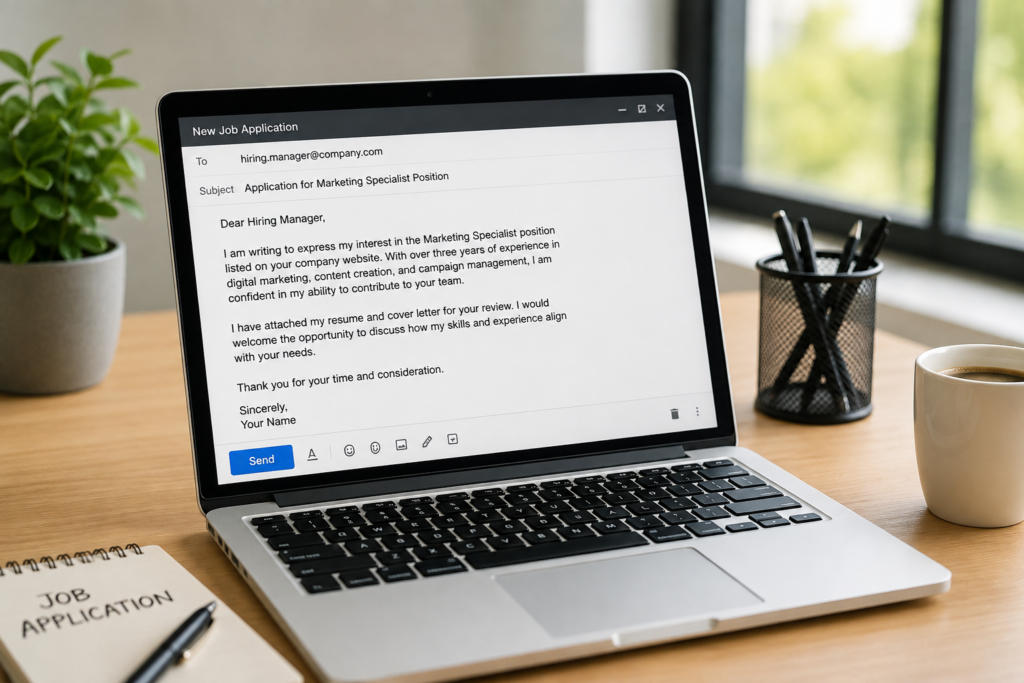
Here is a simple example that you can adapt to your own situation:
Subject: Application for Content Writer Position | John Smith
Dear Hiring Manager,
I am writing to apply for the Content Writer position advertised on your company website. I have experience creating clear, engaging, and search optimized content for online audiences, and I believe my writing skills would be a strong match for this position.
In my previous work, I have developed blog articles, website content, and marketing materials while focusing on accuracy, readability, and audience engagement. I am particularly interested in this opportunity because of your company’s focus on producing useful and high quality digital content.
I have attached my resume for your review, which provides additional information about my experience and qualifications. I would appreciate the opportunity to discuss how my skills could contribute to your team.
Thank you for your time and consideration. I look forward to hearing from you.
Sincerely,
John Smith
Phone: Your Phone Number
Email: Your Email Address
Common Mistakes to Avoid
There are several mistakes that can weaken a job application email.
First, do not send a blank email with only your resume attached. Even if the employer receives the document, the message can appear careless.
Second, do not use an unclear subject line. Make the purpose of your email obvious.
Third, avoid writing a long story about your personal circumstances. Focus on your professional qualifications and the value you can bring to the employer.
Fourth, never exaggerate your experience or qualifications. Honest applications create a stronger professional foundation.
Finally, do not send the email without checking your attachments. This simple step can prevent an unnecessary mistake.
Final Thoughts
Learning how to write a professional job application email can make your job search more effective. Your email does not need to impress the employer with complicated language. It needs to communicate your purpose clearly and show that you understand professional communication.
In my opinion, the best approach is to keep the email short, personalize it for the position, highlight your most relevant qualifications, and make it easy for the hiring manager to review your application.
Use a clear subject line, professional greeting, concise introduction, relevant experience, and polite closing. Proofread everything before pressing send, and always check that your resume and other documents are attached.
A professional job application email may only take a few minutes to write, but those few minutes can make a meaningful difference in how your application is received. When your email is clear, organized, and respectful, you give the employer a good reason to open your resume and learn more about you.