
Related Articles



Writing a professional freelance proposal is one of the most important skills a freelancer can develop. When you are applying for freelance projects, your proposal is often the first real conversation between you and a potential client. A good proposal can show that you understand the project, have the right skills, and can be trusted to deliver quality work.
In my experience, a successful freelance proposal is not about writing a very long message or using complicated words. It is about understanding what the client needs and explaining clearly how you can help. Whether you are a beginner or an experienced freelancer, learning how to write a professional freelance proposal can improve your chances of getting clients and building long term relationships.
What Is a Freelance Proposal?
A freelance proposal is a short document or message that a freelancer sends to a potential client after finding a project. It explains your understanding of the client’s requirements, your skills, your approach to the project, expected delivery time, and pricing.
Many freelancers make the mistake of treating a proposal like a resume. I believe this is one of the biggest mistakes you can make. A resume mainly talks about your background, while a freelance proposal should focus more on the client’s problem and how you can solve it.
For example, if a client needs website content, do not spend most of your proposal talking about yourself. Instead, explain that you understand the type of content they need and briefly describe how you will create useful, original, and search friendly content for their audience.
Start by Understanding the Client’s Requirements
Before writing your proposal, carefully read the entire project description. This simple step can make a major difference.
Clients want to know that freelancers have actually read their requirements. If you send a general proposal that could be sent to hundreds of clients, it may immediately look like a copy and paste message.
I recommend identifying three important things before you start writing.
First, understand exactly what the client wants.
Second, identify the main problem they are trying to solve.
Third, think about how your skills can help them achieve their goal.
For example, if a client is looking for a blog writer, they may not simply need someone who can write articles. They may need someone who understands SEO, research, readability, formatting, and their target audience.
Your proposal should show that you understand these details.
Create a Strong Opening
The first few lines of your freelance proposal are extremely important. Clients often receive many proposals, so you need to give them a reason to continue reading.
Instead of starting with a generic sentence such as “Dear Sir, I am interested in your project,” try to make your opening relevant to the client’s needs.
You could say something like:
“I understand that you are looking for SEO friendly blog content that is informative, easy to read, and suitable for your target audience. I can help you create well structured articles that focus on both reader value and search visibility.”
This type of introduction immediately connects your skills with the client’s requirement.
A strong opening should be clear, professional, and specific. You do not need to exaggerate your abilities.
Explain How You Can Help
After the introduction, explain what you can bring to the project.
This is where you should connect your experience and skills with the client’s needs. Instead of listing every skill you have, mention only the skills that are relevant to the project.
For example, if you are applying for a graphic design project, you might discuss your ability to create clean and professional designs based on the client’s brand style.
If you are applying for a content writing project, you can mention research, SEO optimization, readability, proper formatting, and original writing.
The goal is to make the client think, “This freelancer understands what I need.”
Show Relevant Experience
Experience can make a proposal stronger, but you do not need years of experience to write a professional freelance proposal.
If you are an experienced freelancer, mention a few relevant projects you have completed. If you are a beginner, focus on your skills, sample work, education, personal projects, or practice work.
One thing I have learned is that relevance is more important than quantity. You do not need to mention ten unrelated projects. Two relevant examples can be more convincing than a long list of unrelated experience.
If you have a portfolio, include a link to your best relevant work when the platform allows it.
Explain Your Work Process
A professional freelance proposal should give the client a basic idea of how you will handle the project.
You do not need to explain every small step. A simple process is enough.
For example, a content writer might explain that they will first understand the target audience, research the topic, create an outline, write the article, optimize it for relevant keywords, proofread it, and then deliver the final version.
This gives the client confidence that you have a clear plan.
A freelancer who explains their process can often appear more organized and professional than someone who simply says, “I can do this project.”
Discuss the Timeline Clearly
Clients want to know when their project will be completed. Therefore, your freelance proposal should include a realistic timeline whenever possible.
Do not promise an extremely fast delivery just to win the project. If you cannot maintain the promised deadline, it can damage your reputation.
For example, you could say:
“I can complete the first draft within three days and provide the final version after receiving your feedback.”
A clear timeline helps both sides understand expectations from the beginning.
Be Transparent About Pricing
Pricing is another important part of a freelance proposal.
If the project already has a fixed budget, consider whether the amount matches the work involved. If you are asked to provide your own price, explain it clearly.
As a beginner, you do not necessarily need to offer the lowest price. Very low pricing can sometimes make clients question the quality of your work.
Instead, focus on providing reasonable value.
Your proposal can briefly explain what is included in your price. For example, you might include research, writing, revisions, formatting, and final delivery.
Clear pricing reduces confusion and helps establish professional expectations.
Keep Your Proposal Short and Focused
One of the biggest mistakes I see in freelance proposals is unnecessary length.
A professional proposal does not need to be five pages long. Most clients want to quickly understand who you are, whether you understand their project, what you can offer, and how you plan to complete the work.
Try to remove information that does not contribute to the proposal.
Avoid writing long personal stories, unnecessary qualifications, or information unrelated to the project.
A focused proposal is easier to read and can make a stronger impression.
Personalize Every Proposal
Personalization is one of the simplest ways to make your freelance proposal stand out.
Instead of sending the same proposal to every client, change your introduction and main points according to the project.
Mention something specific from the client’s description. This shows that you actually read the project before applying.
For example:
“I noticed that you need product descriptions for a fashion store and want the content to sound natural rather than overly promotional.”
This is much stronger than saying:
“I am a professional writer and can complete your project.”
Personalization does not mean rewriting everything from zero every time. You can have a basic structure and customize the important parts for each client.
Avoid Common Freelance Proposal Mistakes
There are several mistakes that can reduce your chances of getting a project.
One common mistake is using generic proposals. Another is focusing too much on yourself instead of the client’s needs.
Poor grammar and spelling can also create a negative impression, especially for writing related projects.
I also recommend avoiding unrealistic promises. Do not claim that you can deliver perfect results if you have not even understood the project.
Another mistake is asking questions that have already been answered in the project description. Read the requirements carefully before asking for clarification.
Finally, avoid sounding desperate. Professional confidence is much more effective than repeatedly saying that you urgently need the project.
End With a Clear Call to Action
The final part of your proposal should encourage the client to continue the conversation.
You can end with a simple question or invitation.
For example:
“I would be happy to discuss your requirements and suggest the best approach for the project. Please let me know if you would like to discuss the details.”
This gives the client an easy reason to respond.
You can also ask one useful project related question if something important needs clarification.
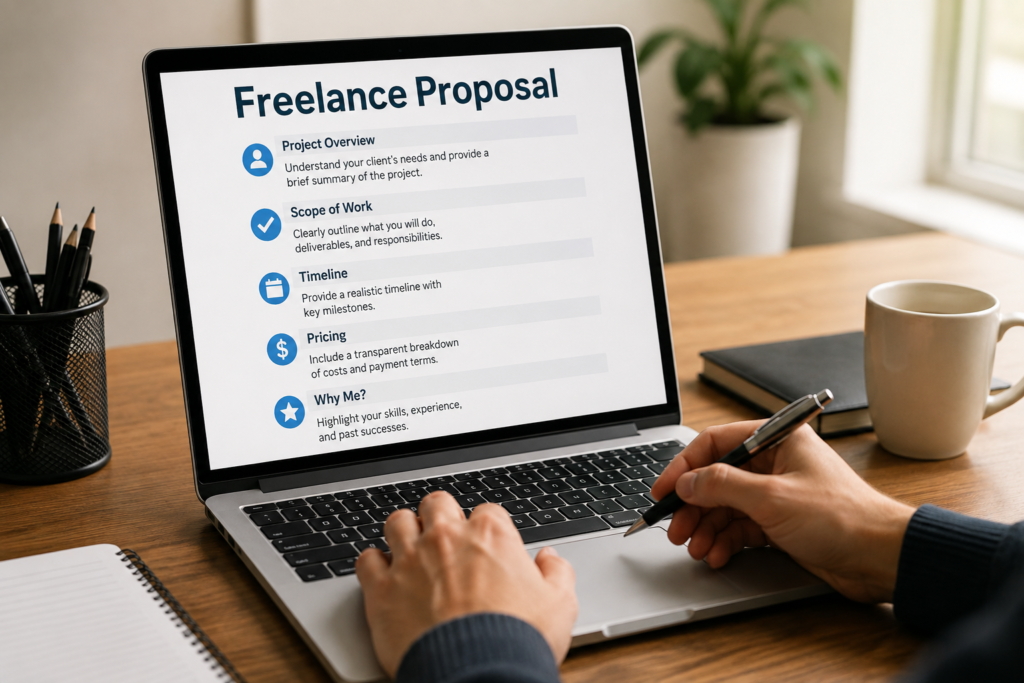
A Simple Freelance Proposal Structure
If you are new to freelancing, you can follow this basic structure:
Start with a personalized opening.
Show that you understand the client’s project.
Explain how your skills can solve their problem.
Mention relevant experience or portfolio work.
Briefly describe your approach.
Provide your estimated timeline.
Discuss pricing when required.
Finish with a professional call to action.
This structure is simple, but it covers the information most clients want to see.
Example of a Professional Freelance Proposal
Here is a simple example that can be adapted for different projects:
“Hello,
I read your project requirements and understand that you are looking for well researched and engaging blog content for your website. I can help you create clear, original, and SEO friendly articles that are written for your target audience.
My approach will be to understand your topic and audience first, research reliable information, create a clear structure, and then write and proofread the final article. I will also focus on readability, keyword placement, headings, and overall content quality.
I can complete the project within the agreed timeline and am happy to make reasonable revisions based on your feedback.
I would be glad to discuss your requirements and get started.”
This example is intentionally simple. You can change it according to your skills and the client’s project.
Final Thoughts
Learning how to write a professional freelance proposal takes practice. You may not receive a response from every client, and that is completely normal. Freelancing is competitive, and clients have different requirements and preferences.
From my point of view, the most important thing is to stop thinking of a proposal as a simple application. Think of it as the beginning of a professional conversation.
Understand the client’s problem, explain how you can help, provide relevant evidence of your skills, and communicate clearly. Keep your proposal honest, personalized, and focused.
As you gain more experience, you will learn which proposal style works best for your niche. You can create a basic proposal structure and improve it over time based on client responses.
A professional freelance proposal does not guarantee that you will win every project. However, a well written proposal can help you make a better first impression, communicate your value, and increase your chances of turning opportunities into actual freelance work.