
Related Articles



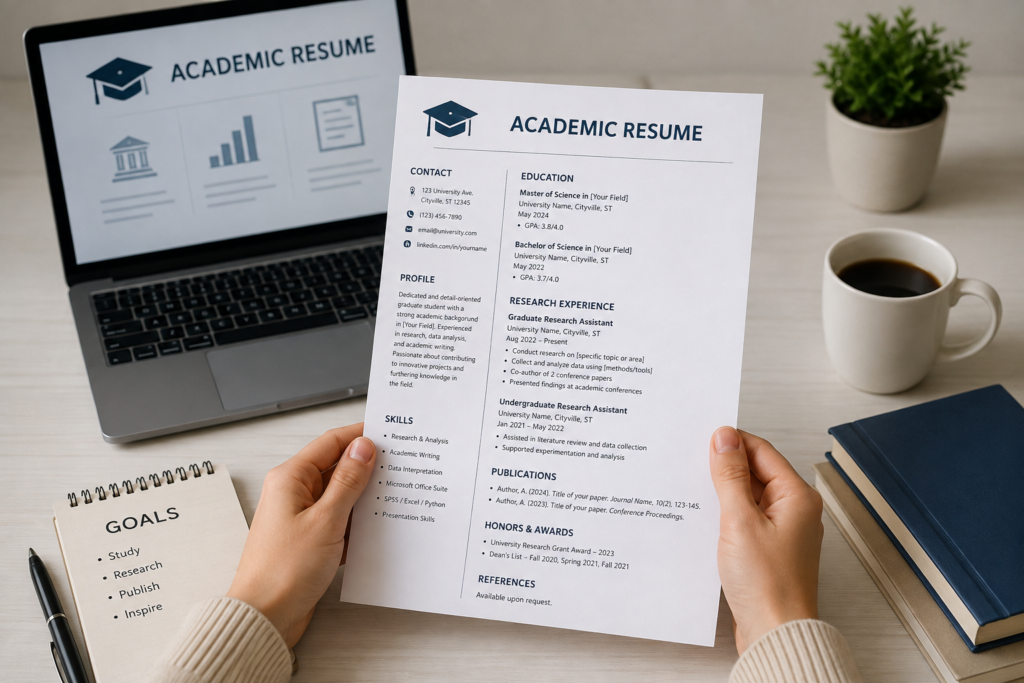
A strong academic resume can make a big difference when you are applying for scholarships, internships, research opportunities, university programs, teaching positions, or your first academic job. In my opinion, an academic resume is not simply a document that lists everything you have done. It is a clear presentation of your education, academic achievements, skills, research experience, and future potential.
Many students have valuable achievements but struggle to present them effectively. They may have good grades, participate in academic projects, attend seminars, complete internships, or receive awards, but their resume does not communicate these strengths clearly. A well organized academic resume helps the reader understand your background quickly and see why you are a suitable candidate.
In this article, I will explain how to build a strong academic resume, what sections to include, what mistakes to avoid, and how to make your resume professional and effective.
What Is an Academic Resume?
An academic resume is a professional document that focuses mainly on your educational background and academic achievements. Unlike a general job resume, an academic resume can give more attention to education, research, publications, academic projects, presentations, awards, certifications, and relevant skills.
For students, an academic resume is especially useful because they may not have extensive professional work experience yet. Instead of focusing only on employment history, the resume can demonstrate their academic potential through projects, coursework, research, leadership, volunteering, competitions, and other accomplishments.
I believe the most important principle is to focus on relevance. You do not need to include every activity you have ever participated in. Include the experiences that support your academic goals.
Start With Clear Contact Information
The first section of your academic resume should make it easy for someone to contact you. Include your full name, phone number, professional email address, city and country, and an appropriate professional profile or LinkedIn account if you have one.
Use an email address that looks professional. Ideally, it should contain your name rather than a nickname or informal phrase.
You generally do not need to include unnecessary personal information such as your marital status, religion, national identification number, or other private details. Keeping your contact section simple makes your resume look cleaner and more professional.
Write a Strong Academic Profile
An academic profile is a short introduction that explains who you are, what you study, and what you want to achieve. It should be specific rather than using general statements.
For example, instead of writing that you are a hardworking student who wants to succeed, explain your field of study, academic interests, relevant experience, and career direction.
A good academic profile might mention your degree, research interests, important skills, and the type of opportunity you are seeking.
I recommend keeping this section short. A few focused sentences are usually enough. The purpose is to encourage the reader to continue reading your resume.
Highlight Your Education
Education is one of the most important sections of an academic resume. List your most recent or current degree first.
For each qualification, include the degree name, university or institution, location, and dates of study. You can also include your GPA or percentage when it is strong and relevant.
For example:
Bachelor of Science in Computer Science
University Name
2023 to Present
GPA: 3.7 out of 4.0
If you have completed important academic projects, you can mention them under your degree. You may also include relevant coursework if it supports the opportunity you are applying for.
Students with limited experience should make their education section particularly strong because it demonstrates their current academic development.
Include Academic Achievements
Academic achievements can help your resume stand out. These may include scholarships, academic awards, dean’s list recognition, competitions, research grants, merit certificates, or other meaningful accomplishments.
Do not simply list an award without context. If possible, explain what the award recognized.
For example, instead of writing:
Academic Award
You could write:
Received a university merit award for outstanding academic performance during the second year of undergraduate study.
This gives the reader a better understanding of your accomplishment.
Even small achievements can be valuable when they are relevant to your academic journey.
Add Research Experience
Research experience is extremely important for students applying to graduate programs, research positions, scholarships, and academic opportunities.
You do not necessarily need to have worked in a formal research laboratory. Research experience can come from university projects, independent studies, research assistant positions, dissertations, final year projects, or academic investigations.
When describing research experience, explain what you worked on and what you actually contributed.
For example, you might mention that you collected data, reviewed academic literature, conducted interviews, analyzed information, used research software, or presented findings.
Try to focus on actions and results rather than simply stating the name of a project.
Mention Academic Projects
Academic projects can strengthen a student’s resume, especially when professional experience is limited.
Choose projects that demonstrate useful knowledge and skills. Describe the project briefly and explain your role.
For example, a computer science student might include a software development project. A business student could mention a market research project. A biology student could describe a laboratory investigation.
Whenever possible, mention the tools, methods, or techniques you used.
A strong project description can show that you know how to apply classroom knowledge to practical problems.
Include Publications and Presentations
If you have published research papers, articles, conference papers, book chapters, or other academic work, create a separate publications section.
List publications using a consistent format. Include the title, publication or journal name, year, and your role as an author.
You can also include academic presentations. University seminars, conferences, research presentations, and poster sessions can demonstrate your ability to communicate academic ideas.
If you do not have publications yet, do not worry. Most students do not have a long publication record. Simply focus on the other strengths you already have.
Show Relevant Academic Skills
The skills section should be specific and relevant to your goals. Avoid filling this section with vague words such as hardworking, motivated, or responsible unless they are supported by actual experience.
Instead, mention practical skills such as academic writing, research methods, data analysis, presentation skills, Microsoft Office, statistical software, programming languages, laboratory techniques, communication, or foreign languages.
The best skills are those that you can demonstrate through your education or experience.
For example, if you list data analysis, your resume should ideally show a project or research experience where you used data analysis.
Add Certifications and Training
Certifications can provide additional evidence of your knowledge and willingness to learn.
Include relevant online courses, professional certifications, workshops, seminars, and academic training. Focus on certifications that are connected to your field or the opportunity you are targeting.
For example, a student interested in data science might include certifications related to Python, statistics, data analysis, or machine learning.
Do not add every short course you have ever taken. Quality and relevance are more important than quantity.
Include Leadership and Extracurricular Activities
Academic success is important, but universities and employers often value students who can contribute beyond the classroom.
Leadership positions, student organizations, volunteering, academic societies, competitions, community projects, and event management can demonstrate communication, teamwork, organization, and leadership skills.
Choose activities that add something meaningful to your application. Explain your contribution instead of simply listing the organization name.
For example, instead of saying that you were a member of a student society, explain that you helped organize academic events, managed registration, coordinated volunteers, or delivered presentations.
Use Strong and Simple Language
The language of your academic resume should be clear and professional. Avoid complicated sentences and unnecessary words.
Use action focused language when describing your experience. Words such as conducted, analyzed, developed, presented, researched, organized, created, assisted, designed, and coordinated can make descriptions more specific.
I also recommend checking your resume carefully for grammar, spelling, punctuation, and formatting errors. A single mistake may appear small, but several mistakes can make a resume look careless.
Reading your resume aloud can help you identify awkward sentences that you might not notice while silently reading.
Keep the Design Professional
A strong academic resume should be easy to read. You do not need excessive colors, graphics, unusual fonts, or complicated layouts.
Use clear headings, consistent spacing, readable fonts, and a logical structure. Make important information easy to find.
For most students, one or two pages are enough. If you have extensive research, publications, teaching experience, or academic achievements, your resume may reasonably become longer.
The goal is not to make the resume visually impressive. The goal is to make your information easy to understand.
Customize Your Academic Resume
One of the most effective improvements you can make is to customize your resume for each opportunity.
If you are applying for a research position, give more attention to research experience, academic projects, publications, and relevant technical skills.
If you are applying for a scholarship, emphasize academic achievements, leadership, community involvement, and your educational goals.
If you are applying for an internship, highlight relevant projects, technical abilities, certifications, and practical experience.
A customized resume shows that you understand the opportunity rather than sending the same document to everyone.
Common Academic Resume Mistakes
There are several mistakes I recommend avoiding.
The first is including too much irrelevant information. A long resume does not automatically mean a strong resume.
The second is using the same resume for every application. Different opportunities require different priorities.
Another common mistake is writing vague descriptions. Saying that you participated in a project is less powerful than explaining what you actually did.
Poor formatting is another problem. Inconsistent fonts, excessive spacing, spelling mistakes, and unclear headings can make a good academic background look less professional.
Finally, never exaggerate your achievements. Your academic resume should be honest. Only include information that you can explain and support if asked.
Review Your Resume Before Sending It
Before submitting your academic resume, take some time to review it carefully.
Check your contact information first. Then review your education dates, academic achievements, project descriptions, certifications, and skills.
Make sure the formatting is consistent throughout the document.
I also recommend asking a teacher, professor, mentor, or trusted person to review your resume. A second person may notice unclear wording or mistakes that you have overlooked.
If possible, save the final version as a PDF before sending it. This helps preserve the formatting across different devices.
Final Thoughts
Building a strong academic resume is not about trying to make yourself look perfect. It is about presenting your real academic journey in a clear, organized, and convincing way.
In my view, the strongest academic resume tells a simple story. It shows where you are academically, what you have achieved, what skills you have developed, what experiences have shaped you, and where you want to go next.
Start with clear contact information and a focused academic profile. Present your education prominently, then include relevant research, projects, achievements, publications, skills, certifications, and leadership activities. Keep the design simple and professional, use accurate information, and customize the resume for every important opportunity.
Remember that your academic resume can grow with you. You do not need dozens of achievements to create a strong resume today. Start with what you have, present it honestly, and continue improving it as you gain new knowledge and experience.
A well prepared academic resume can help you communicate your potential before you even enter the interview room. With careful organization, relevant keywords, strong descriptions, and regular updates, your resume can become a valuable tool for reaching your academic and professional goals.