Related Articles

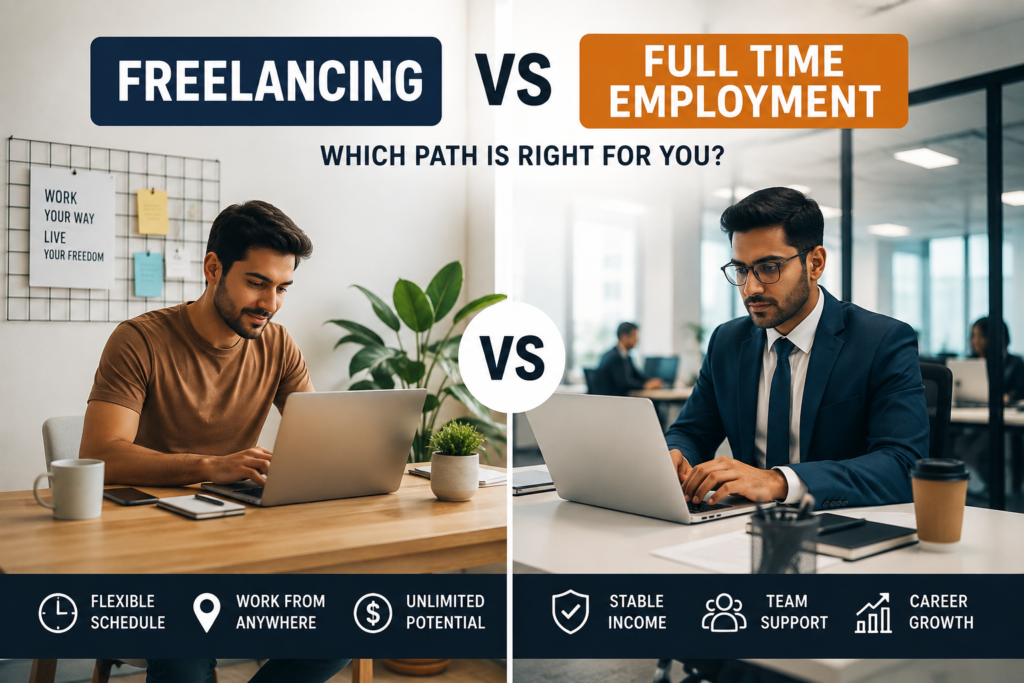
Choosing between freelancing and full time employment is one of the biggest career decisions many people face today. Both options can provide a good income, professional growth, and a satisfying career, but the experience can be very different. From my point of view, there is no single answer that works for everyone. The right choice depends on your skills, financial goals, personality, lifestyle, and how much freedom or stability you want.
I have seen how freelancing can provide flexibility and independence, while full time employment can offer stability and a structured career path. Before choosing either option, it is important to understand the advantages and challenges of both.
What Is Freelancing?
Freelancing means working independently for clients instead of being permanently employed by one company. A freelancer can work with several clients and choose projects based on their skills, interests, and availability.
Freelancers commonly work in areas such as writing, graphic design, web development, digital marketing, video editing, programming, virtual assistance, and many other online services.
One of the biggest benefits of freelancing is flexibility. You can often decide when you work, where you work, and which projects you want to accept. For people who value independence, this can be a major advantage.
However, freelancing also requires discipline. Nobody is standing over you and telling you what to do every morning. You have to find clients, manage deadlines, communicate professionally, handle payments, and continue improving your skills.
What Is Full Time Employment?
Full time employment usually means working for one company or organization under an employment agreement. Employees normally have fixed working hours, defined responsibilities, and regular salaries.
Depending on the company and position, full time employees may also receive benefits such as paid holidays, bonuses, health coverage, retirement plans, training, and other workplace benefits.
From my perspective, one of the strongest advantages of full time employment is financial predictability. Knowing that a salary will arrive regularly can make it easier to plan monthly expenses and long term goals.
The downside is that employees generally have less control over their schedule. They may also have to follow company policies, attend meetings, work specific hours, and accept tasks assigned by management.
Freelancing vs Full Time Employment: Income
Income is an important factor when comparing freelancing vs full time employment.
With a full time job, your salary is usually fixed. You know approximately how much you will earn each month, which makes budgeting easier. Salary increases may come through promotions, annual raises, or changing jobs.
Freelancing works differently. Your income can change from month to month. Some months can be extremely profitable, while other months may be slower.
The interesting thing about freelancing is that your earning potential can grow as your skills and reputation improve. A freelancer who develops specialized skills and builds strong relationships with clients can potentially earn more than a traditional employee.
However, higher earning potential does not automatically mean higher income. Freelancers must actively search for clients and maintain a consistent workflow.
Flexibility and Freedom
This is where freelancing has a major advantage.
A freelancer can often create a schedule that fits their lifestyle. If you are more productive at night, you may be able to work at night. If you prefer working from home, you can create a home office and avoid daily commuting.
Full time employees usually have a more structured schedule. They may need to arrive at work at a specific time and remain available during working hours.
For me, flexibility is one of the biggest reasons people become interested in freelancing. The ability to manage your own time can improve your work and personal life when handled responsibly.
At the same time, too much flexibility can become a problem. Without a proper routine, freelancers may procrastinate or work irregular hours.
Job Security
When it comes to job security, full time employment generally has an advantage.
Employees receive a regular salary as long as they remain employed. Although companies can experience layoffs or financial problems, employees normally do not need to search for a new client every month.
Freelancers have a different type of security. They may have several clients instead of one employer. Losing one client does not necessarily mean losing all income.
This is why I believe experienced freelancers should avoid depending completely on one client. Building multiple client relationships can reduce financial risk.
Work Life Balance
Work life balance depends heavily on the individual.
Freelancing can provide excellent work life balance because you have more control over your schedule. You can take breaks, work from home, and organize your day around personal responsibilities.
However, some freelancers make the mistake of working all the time. Because their laptop is always nearby, they may continue working late at night or during weekends.
Full time employment can provide clearer boundaries. When the working day ends, employees may be able to leave their work at the office.
However, long commutes, overtime, workplace pressure, and meetings can also affect work life balance.
The best option is the one that matches your personality and ability to maintain healthy boundaries.
Career Growth
Career growth looks different in freelancing and full time employment.
In a traditional job, career growth may follow a clear path. You might start as a junior employee, become a senior employee, move into management, and eventually reach a leadership position.
Companies may also provide training and mentorship that helps employees develop professionally.
Freelancers create their own career paths. They can specialize in a particular skill, increase their rates, build an agency, create digital products, or develop their own business.
I personally think freelancing can provide tremendous career growth for people who are willing to continuously learn. Your reputation, portfolio, communication skills, and ability to deliver quality work can directly influence your opportunities.
Skills You Need for Freelancing
Freelancing requires more than technical skills.
Of course, you need a marketable skill that clients are willing to pay for. But you also need communication, time management, negotiation, problem solving, and basic business skills.
You also need to understand how to present yourself professionally. A strong portfolio can help potential clients understand what you can do.
Another important skill is client management. Even if you are excellent at your work, poor communication can damage your reputation.
For anyone considering freelancing, I recommend developing both your professional skill and your business skills.
Benefits of Full Time Employment
Full time employment offers several advantages.
The first is predictable income. A regular salary can make financial planning easier.
The second is workplace structure. Employees usually know their responsibilities and working hours.
The third is access to company resources. Depending on the employer, employees may receive training, equipment, insurance, paid leave, and other benefits.
Another advantage is networking. Working with colleagues can help you develop professional relationships and learn from experienced people.
For someone who prefers structure and stability, full time employment can be an excellent choice.
Benefits of Freelancing
Freelancing also offers many benefits.
The biggest advantage is independence. You can choose your clients and projects more freely than an employee can choose their assignments.
Another benefit is location flexibility. Many freelance jobs can be completed remotely, allowing people to work from home or another suitable location.
Freelancing can also provide multiple income opportunities. Instead of relying on one salary, you can work with several clients and potentially develop additional income streams.
You also have greater control over your professional direction. If you want to move into a different niche, you can learn new skills and start targeting different clients.
Challenges of Freelancing
Freelancing is not perfect.
Finding clients can be difficult when you are starting. Competition can also be high, especially for popular services.
Income can be unpredictable, and freelancers are responsible for managing their own finances. They may also need to handle taxes, software expenses, equipment costs, and other business expenses.
Another challenge is isolation. People who enjoy working with colleagues may miss the social environment of an office.
These challenges do not mean freelancing is a bad choice. They simply mean that freelancing should be treated as a professional career rather than an easy way to make money online.
Challenges of Full Time Employment
Full time employment also has disadvantages.
Employees usually have less freedom over their schedules. They may have to follow workplace rules and complete tasks assigned by management.
Office politics can sometimes create stress. Some employees may also feel that their salary does not grow as quickly as their responsibilities.
Commuting can be another major issue, especially in large cities.
Some people also feel limited because their career development depends partly on the opportunities available within their company.
Freelancing vs Full Time Employment: Which Is Better?
In my opinion, neither option is universally better.
If you value stability, predictable income, workplace benefits, teamwork, and a structured career path, full time employment may be the better choice.
If you value independence, flexible working hours, remote work, multiple clients, and greater control over your career, freelancing may be more suitable.
There is also a third option that many people overlook. You can start freelancing while maintaining a full time job. This approach allows you to develop freelance skills and build a client base without immediately giving up your regular income.
Once your freelance income becomes consistent, you can decide whether moving into full time freelancing makes sense.
Final Thoughts
The debate between freelancing vs full time employment is not really about which option is better. It is about which option is better for your current situation.
Freelancing can provide freedom, flexibility, and potentially unlimited earning opportunities, but it requires discipline, patience, and business skills. Full time employment can provide stability, benefits, teamwork, and a structured career path, but it usually offers less flexibility.
From my point of view, the smartest career decision is to understand your priorities before making a change. Think about your financial responsibilities, skills, personality, lifestyle, and long term goals.
If you are comfortable with uncertainty and enjoy building your own opportunities, freelancing can be an exciting career path. If you prefer predictable income and a structured professional environment, full time employment may be a better fit.
The good news is that your decision does not have to be permanent. Skills can be developed, careers can change, and many people successfully move between freelancing and employment during their professional lives. What matters most is choosing the path that helps you build a stable, rewarding, and sustainable future.