Related Articles

Creating a good blog post starts with a strong outline. From my experience, writing an article without planning the structure can make the writing process slower and more difficult. I may have good ideas in my mind, but if I do not organize those ideas properly, the final article can become confusing or repetitive. This is where AI tools for creating blog outlines can be very useful.
AI writing tools have changed the way many bloggers approach content creation. Instead of spending a long time deciding what headings to use, what questions readers may have, or how to organize different sections, I can use an AI tool to create a starting structure within minutes. I still review and improve the outline because I believe human judgment is important, but AI can make the first step much easier.
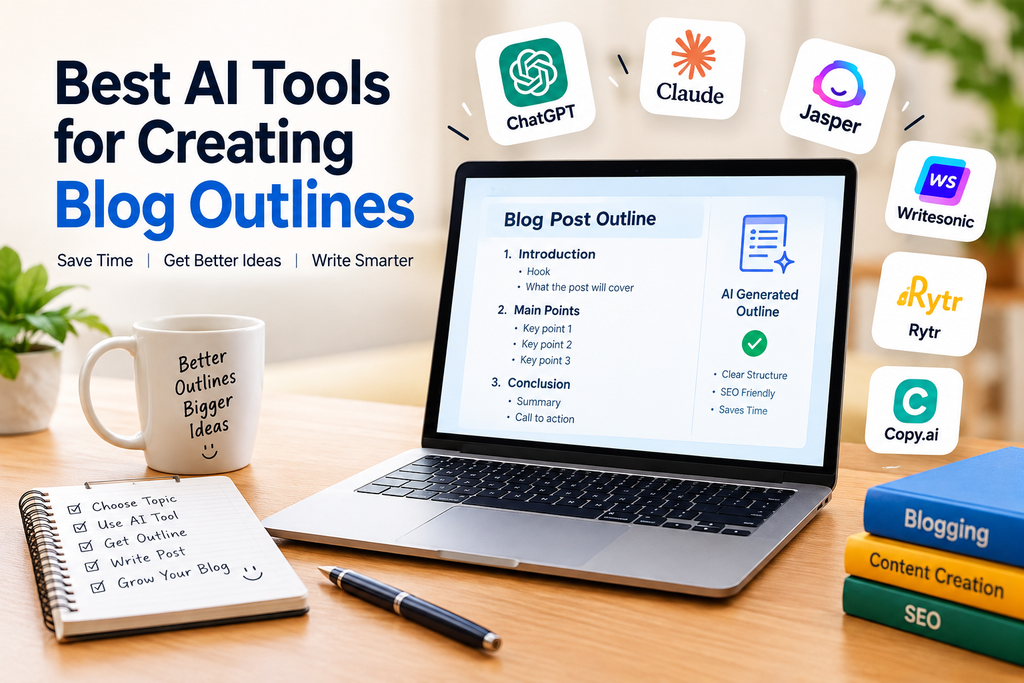
In this article, I will discuss some of the best AI tools for creating blog outlines, what makes them useful, and how I would use them for SEO friendly blog content.
Why a Blog Outline Is Important
Before discussing the best AI tools for blog outlines, I think it is important to understand why an outline matters.
A blog outline gives an article a clear structure. It normally includes the introduction, main headings, subheadings, important points, and conclusion. When I have a proper outline, I know exactly what I need to discuss in every section.
An outline can also help prevent unnecessary repetition. For example, if I am writing about beginner fitness tips, I can plan sections for exercise, nutrition, sleep, consistency, and common mistakes. This makes it easier to cover the topic naturally without repeating the same information.
A strong outline can also support SEO. Search engines want useful content that answers the questions readers are looking for. An organized structure with relevant headings can make the content easier for both readers and search engines to understand.
1. ChatGPT
ChatGPT is one of the most flexible AI tools for creating blog outlines. I find it especially useful because I can provide detailed instructions about the topic, target audience, keyword, writing style, and article length.
For example, I can ask ChatGPT to create an outline for a 1300 word article targeting a specific keyword. I can also ask it to include an introduction, H2 headings, H3 subheadings, frequently asked questions, and a conclusion.
One advantage is that I can continue the conversation and improve the outline. If the first structure feels too general, I can ask for more specific sections. If I want a beginner friendly article, I can ask the tool to simplify the structure.
For bloggers who want flexibility, I consider ChatGPT one of the best AI tools for creating blog outlines.
2. Claude
Claude is another AI assistant that can be useful for content planning. I like the way AI assistants can analyze a topic from different angles and suggest sections that I might not have considered.
When creating a blog outline, I can provide the main topic and explain what type of readers I want to reach. Claude can then suggest a logical structure that moves from basic information to more detailed points.
I would still review the suggestions before using them. An AI generated outline is a starting point rather than a finished content strategy. I normally remove sections that do not add real value and keep the points that are most relevant to the reader.
3. Jasper
Jasper is designed with content marketing and business writing in mind. For bloggers and marketers who regularly produce content, it can be useful for generating structured ideas.
I can use an AI writing platform like Jasper to brainstorm topics, create headings, and develop content ideas around a primary keyword. This can be helpful when I am working on several articles and do not want every article to follow exactly the same structure.
Another benefit is that content marketers can use an outline as the foundation for a larger content campaign. A single topic can be expanded into supporting articles, social media content, and other marketing materials.
4. Writesonic
Writesonic is another popular AI writing platform that can help with blog planning. It is useful when I want to move from an article idea toward a more complete content structure.
For example, I can start with a keyword such as “best AI tools for bloggers.” The tool can help develop possible sections around the subject. I can then review the headings and decide which ones actually match the search intent.
This review process is important. I do not recommend adding every AI generated heading simply because the tool suggested it. The goal should always be to create useful content for readers.
5. Copy.ai
Copy.ai is well known for AI powered content creation and can also be useful during the planning stage. When I have a broad topic but am unsure about the best angle, an AI content tool can help generate ideas.
For example, instead of simply writing an article called “AI Tools,” I can explore more focused angles such as AI tools for bloggers, AI tools for students, AI tools for small businesses, or AI tools for content planning.
This type of brainstorming can help me find a more specific topic and create a better outline around it.
6. Rytr
Rytr is another AI writing assistant that can help with content ideas and structure. I find tools like this useful for smaller blogging projects because they can quickly provide suggestions without requiring a complicated planning process.
I can enter my topic, select an appropriate writing approach, and use the generated ideas to build my outline.
The most important thing is to use the generated material as assistance rather than blindly copying it. I prefer to take the useful ideas, arrange them according to my own plan, and then write the article in my own voice.
How I Create an SEO Friendly Blog Outline With AI
Using an AI tool alone does not automatically create a good SEO outline. I believe the quality of the instructions makes a big difference.
First, I choose the primary keyword. For this article, the main keyword is “best AI tools for creating blog outlines.” I then think about related phrases that readers might search for, such as AI blog outline generator, AI tools for bloggers, SEO blog outlines, and blog content planning.
Next, I identify the search intent. Someone searching for the best AI tools for creating blog outlines probably wants to compare different tools and understand which one may work best for their needs.
After that, I ask the AI tool to create a logical structure. I prefer an introduction followed by several useful sections, practical information, and a conclusion.
I also check whether the outline answers common reader questions. If an important question is missing, I add it manually.
What Makes a Good AI Generated Outline?
In my opinion, a good blog outline should be simple, logical, and useful.
The introduction should explain what the reader will learn. The main sections should follow a natural order. Every heading should have a clear purpose.
I also prefer headings that directly communicate what the section is about. Readers should be able to scan the article and understand its value quickly.
Another important factor is keyword placement. The primary keyword can appear naturally in the title and introduction, while related keywords can be included in relevant headings and sections. I avoid forcing keywords because readability should always come first.
AI Should Assist, Not Replace the Writer
Although AI tools can save a lot of time, I do not think they should completely replace human thinking.
AI can generate an outline quickly, but it does not automatically know my personal experience, opinions, examples, or the exact needs of my audience. That is why I always recommend reviewing an AI generated outline before writing.
I may change the order of sections, remove unnecessary ideas, add personal examples, or introduce questions that I believe readers will appreciate.
This combination of AI assistance and human judgment can produce much better results than relying completely on either one.
Benefits of Using AI for Blog Outlines
The biggest benefit is time savings. Instead of spending a long time staring at a blank document, I can start with a structure.
AI can also help when I experience writer’s block. Sometimes I know the topic but cannot decide how to organize my thoughts. A generated outline gives me a starting point.
Another advantage is consistency. If I publish several articles every week, having a repeatable outlining process can make content production easier.
AI can also help identify different angles. A topic that initially looks simple may have several useful subtopics that I had not considered.
Common Mistakes to Avoid
One mistake is accepting an AI outline without reviewing it. Some generated outlines may contain repetitive or irrelevant sections.
Another mistake is focusing too heavily on keywords. SEO is important, but an article should still sound natural.
I also avoid making every article follow exactly the same template. Readers can notice when content feels overly repetitive.
Finally, I would not rely on AI for personal experience that I have not actually experienced. If an article requires firsthand knowledge, I prefer to add genuine observations and examples.
My Recommended AI Blog Outline Workflow
My preferred workflow is quite simple.
I start by choosing a specific topic and primary keyword. Then I identify what the reader wants to know. After that, I ask an AI tool to generate several possible outlines.
I compare the suggestions and select the strongest structure. I then modify the headings according to my own ideas and remove anything unnecessary.
Once the outline is ready, I begin writing each section. During the writing process, I make sure the content provides real information instead of simply filling space.
Before publishing, I check the article for readability, keyword usage, factual accuracy, grammar, and overall usefulness.
Final Thoughts
The best AI tools for creating blog outlines can make content planning faster and easier. Tools such as ChatGPT, Claude, Jasper, Writesonic, Copy.ai, and Rytr can all provide useful assistance when I need ideas or a structured starting point.
However, I believe the best results come from combining AI with human judgment. AI can help me organize ideas, discover possible sections, and overcome writer’s block, but I still need to decide what information is valuable for my readers.
For bloggers who want to save time while creating SEO friendly content, an AI blog outline generator can be a practical part of the writing process. My approach is to use AI for planning, then add my own knowledge, opinions, examples, and editing before publishing.
That way, the final article does not simply look like automatically generated content. Instead, it has a clear structure while still providing a natural and useful reading experience.