
Related Articles



When I started learning about SEO, one thing that confused me was the difference between short tail and long tail keywords. Both are important for getting traffic from search engines, but they work in very different ways. Many beginners think that choosing a keyword with a high search volume is always the best strategy. From my experience and understanding of SEO, that is not always true.
A good keyword is not simply the one that gets the most searches. It is the keyword that matches the purpose of your content, the needs of your audience, and the level of competition you can realistically handle.
In this article, I will explain short tail vs long tail keywords, how they work, their advantages and disadvantages, and how I would use both types in a practical SEO strategy.
What Are Short Tail Keywords?
Short tail keywords are broad search terms that usually contain one or two words. They describe a general topic rather than a very specific search intention.
Some examples include:
- SEO
- Digital marketing
- Running shoes
- Web design
- Healthy recipes
- Travel tips
These keywords usually have a large search volume because many different people can use them for different reasons.
For example, someone searching for “running shoes” could be looking for shoes for walking, running, training, racing, or simply comparing different brands. The search does not tell us exactly what the person wants.
This broad nature makes short tail keywords attractive, but it also makes them highly competitive.
What Are Long Tail Keywords?
Long tail keywords are longer and more specific search phrases. They usually contain three or more words and provide a much clearer idea of what the searcher wants.
Examples include:
- Best running shoes for beginners
- How to choose running shoes for flat feet
- Best SEO tools for small businesses
- How to do keyword research for a new website
- Healthy dinner recipes for busy families
Long tail keywords normally have lower search volume than short tail keywords. However, they often have lower competition and stronger search intent.
For me, this is one of the biggest advantages of long tail keywords. Instead of trying to attract everyone, you can create content for a specific group of people who already know what they are looking for.
Short Tail vs Long Tail Keywords
The main difference between short tail and long tail keywords is their level of specificity.
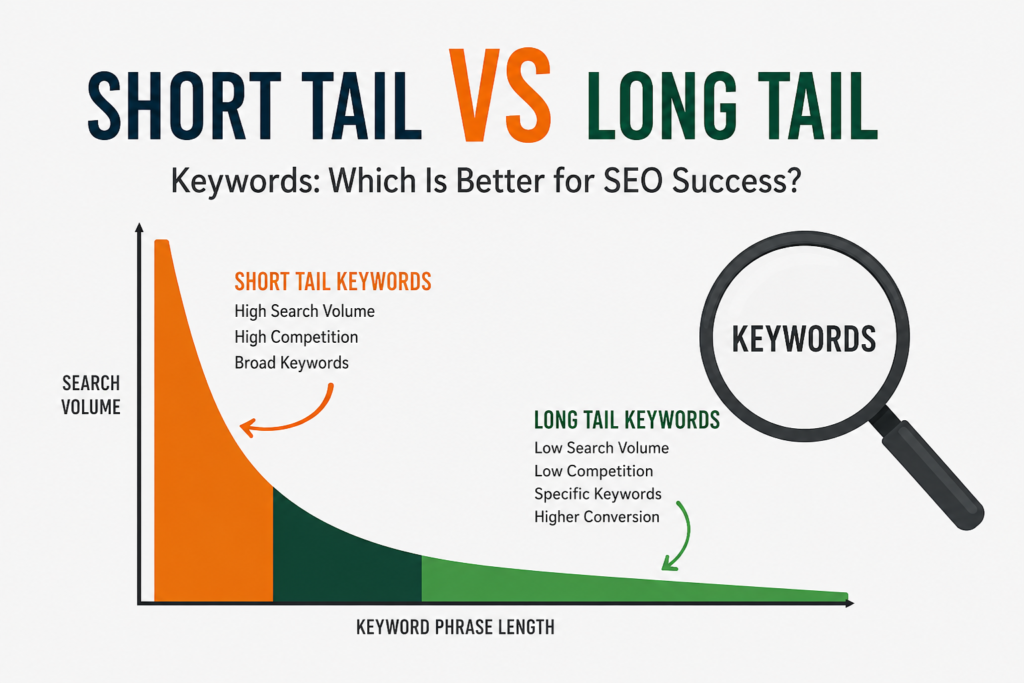
Short tail keywords are broad, general, and usually have higher search volume. Long tail keywords are specific, detailed, and usually have lower search volume.
For example, consider the keyword “SEO.” It is a short tail keyword. A person searching for it could want an SEO definition, an SEO course, SEO tools, SEO services, or SEO strategies.
Now consider “how to improve SEO for a small business website.” This is a long tail keyword. The search intent is much clearer.
This difference is extremely important when creating content.
Search Volume and Competition
Short tail keywords usually receive more searches. At first, this may seem like a major advantage. More searches can potentially mean more visitors.
The problem is that high search volume usually attracts more competition. Large websites, established brands, and websites with strong authority may already be ranking for these keywords.
A new website can find it difficult to compete with them.
Long tail keywords usually have lower search volume, but they can be much easier to target. Instead of competing for one extremely popular keyword, you can target several specific phrases that are related to your topic.
For a new or small website, I believe this can be a much more realistic approach.
Search Intent Matters
One of the most important things I consider when choosing keywords is search intent.
Search intent means the reason behind a person’s search.
Someone searching for “laptops” has a very broad intention. They may want to learn about laptops, compare products, read reviews, or buy one.
Someone searching for “best laptop for video editing under 1000 dollars” has a much clearer intention.
This is where long tail keywords can be powerful.
Because long tail keywords are more specific, they often give you a better understanding of what the reader expects to find. You can then create content that directly answers that need.
Advantages of Short Tail Keywords
Short tail keywords have several advantages.
Higher Search Volume
The biggest advantage is search volume. Popular short tail keywords can attract a large number of searches every month.
If a website manages to rank highly for a valuable short tail keyword, it can potentially receive significant organic traffic.
Broad Audience
Short tail keywords can help websites reach a wider audience. They are useful when your goal is to build general awareness around a topic.
For example, a website about digital marketing may want to establish authority around broad topics such as SEO, content marketing, and social media marketing.
Strong Topic Relevance
Short tail keywords can also help search engines understand the main subject of a website or page. They can work well as part of a broader keyword strategy.
However, I would not rely on them alone.
Disadvantages of Short Tail Keywords
The biggest problem with short tail keywords is competition.
Ranking for a keyword such as “SEO” can be extremely difficult because many authoritative websites are targeting the same topic.
Another problem is unclear search intent. A broad keyword does not always tell you what the user wants.
This can make it harder to create content that perfectly satisfies the searcher.
There is also the possibility of receiving traffic that does not convert well. A large number of visitors is not always useful if those visitors are not interested in your product, service, or content.
Advantages of Long Tail Keywords
Long tail keywords have become an important part of modern SEO strategies.
Lower Competition
Long tail keywords are often easier to rank for because fewer websites target the exact phrase.
This can be especially useful for new websites that do not yet have strong domain authority.
Better Search Intent
Long tail keywords usually provide more information about what the user wants.
For example, “best budget headphones for online classes” is much more specific than “headphones.”
This allows you to create content that directly answers the reader’s question.
Better Conversion Potential
Specific searches can often bring people who are closer to taking action.
Someone searching for “best running shoes for beginners” may already be researching a purchase. Someone searching for “running shoes” could simply be browsing.
This does not mean every long tail keyword automatically converts better, but the specific intent can make it easier to create targeted content.
Easier Content Planning
Long tail keywords can also give me ideas for blog posts.
Instead of writing a very general article about SEO, I can create focused articles around questions such as how to choose keywords, how to perform keyword research, or how to improve rankings.
This creates a more organized content strategy.
Disadvantages of Long Tail Keywords
The biggest disadvantage is lower search volume.
A very specific keyword may only receive a small number of searches each month. If you target only one long tail keyword, the potential traffic may be limited.
Another challenge is keyword variation.
People can search for the same information using different phrases. For example, one person might search for “best SEO tools for beginners,” while another might search for “SEO tools for SEO beginners.”
This is why I prefer creating useful content around a topic instead of forcing one exact keyword into every sentence.
Which Keywords Should Beginners Use?
If you are starting a new website, I would generally focus more on long tail keywords.
The reason is simple. Ranking for highly competitive short tail keywords can take a long time.
Long tail keywords allow you to target smaller topics and build organic traffic gradually.
For example, instead of immediately targeting “digital marketing,” you could start with keywords such as “digital marketing tips for small businesses” or “how to create a digital marketing strategy for a new business.”
As your website gains authority, you can gradually target broader keywords.
This approach feels more realistic and sustainable to me.
Should You Avoid Short Tail Keywords?
No. I do not think short tail keywords should be ignored.
They can still be valuable for your overall SEO strategy.
A good website can use short tail keywords to define major topics and long tail keywords to cover specific questions related to those topics.
For example, if your main topic is “SEO,” you can create supporting articles around long tail keywords such as “how to do keyword research,” “how to write SEO friendly blog posts,” and “how to improve on page SEO.”
Over time, these related articles can help build topical depth.
How to Use Short Tail and Long Tail Keywords Together
I believe the best strategy is not short tail versus long tail. It is short tail and long tail.
Start by identifying your main topic.
Then find specific questions and phrases related to that topic.
For example, imagine your main short tail keyword is “keyword research.”
You could create supporting content around phrases such as:
- How to do keyword research for a website
- Best keyword research methods for beginners
- How to find long tail keywords
- How to choose keywords for blog posts
- Keyword research mistakes to avoid
The broad keyword gives you the main subject, while long tail keywords help you cover specific search needs.
This creates a natural content structure.
How to Choose the Right Keyword
When I choose a keyword, I look at more than search volume.
First, I consider whether the keyword is relevant to my website.
Second, I look at search intent. I want to understand what type of content people expect to see.
Third, I consider competition. A keyword may have excellent search volume, but if the competition is far beyond my current website authority, it may not be the best target.
Finally, I think about the value of the traffic.
A smaller number of highly relevant visitors can sometimes be more valuable than thousands of visitors who have no interest in what the website offers.
Final Thoughts
The debate between short tail vs long tail keywords does not really have one simple winner. Both keyword types have their place in SEO.
Short tail keywords can provide high search volume, broad visibility, and strong topic relevance. However, they are usually more competitive and can have unclear search intent.
Long tail keywords usually have lower search volume, but they can offer more specific search intent, lower competition, and strong opportunities for targeted traffic.
From my point of view, beginners should not become obsessed with high volume keywords. Building SEO success is not just about getting the biggest number of searches. It is about attracting the right people and giving them exactly what they are looking for.
I would start with relevant long tail keywords, create genuinely useful content, and gradually work toward broader short tail keywords as the website becomes stronger.
The most effective SEO strategy is usually a balanced one. Use short tail keywords to understand the bigger topic and long tail keywords to answer the specific questions people are asking. When both work together naturally, they can create a strong foundation for long term organic traffic.