
Related Articles


An employment gap on a resume can feel uncomfortable, especially when you are applying for a new job and wondering what a hiring manager might think. In my opinion, an employment gap is not automatically a negative thing. People leave jobs for many different reasons, and career paths are rarely perfectly straight. What matters most is how you present the gap and whether you can show that you are ready and qualified for the opportunity you want.
The best way to explain employment gaps on a resume is to be honest, positive, and professional. You do not need to provide every personal detail. Instead, focus on what you were doing during that period and what you learned from the experience.
What Is an Employment Gap?
An employment gap is a period when you were not working in a traditional full time or part time job. The length can vary from a few months to several years.
A short gap between jobs is usually not something to worry about. Many professionals take time to search for the right position after leaving a company. However, a longer employment gap may raise questions for an employer, particularly if there is no explanation on the resume.
An employment gap can happen for many normal reasons. You may have been looking for a new job, studying, caring for family, traveling, dealing with personal responsibilities, starting a business, or developing new skills.
Instead of thinking about the gap as something you must hide, I believe it is better to think about how you can explain it in a way that shows responsibility and growth.
Should You Explain an Employment Gap on Your Resume?
Not every employment gap needs a detailed explanation.
If you were unemployed for only a few months, you may simply list your previous job and your next position using years instead of exact months. This can make your resume cleaner and easier to read.
For example, instead of writing:
January 2021 to March 2023
April 2023 to June 2023
You might write:
2021 to 2023
2023
However, I would not recommend hiding a significant employment gap. If you have been away from traditional employment for a year or longer, providing some context can help the hiring manager understand your career history.
The goal is not to make excuses. The goal is to provide useful information.
Be Honest About Your Employment Gap
Honesty should always be the foundation of your resume. It may be tempting to create a job title or extend employment dates to make your career history look continuous, but this can create serious problems later.
Employers may verify employment information during the hiring process. If the information on your resume does not match your actual history, you could lose an opportunity that you might otherwise have received.
You can explain an employment gap without sharing private information that you do not want to discuss.
For example, if you left work to handle family responsibilities, you can simply write:
Career Break for Family Responsibilities
2022 to 2023
Managed family responsibilities while maintaining professional development through online courses and independent learning.
This gives enough information without revealing unnecessary personal details.
Use a Simple Resume Format
A clear resume format can make employment gaps easier to understand.
I recommend using a chronological resume format when your work history is strong and easy to follow. List your jobs in reverse chronological order and use consistent dates throughout the document.
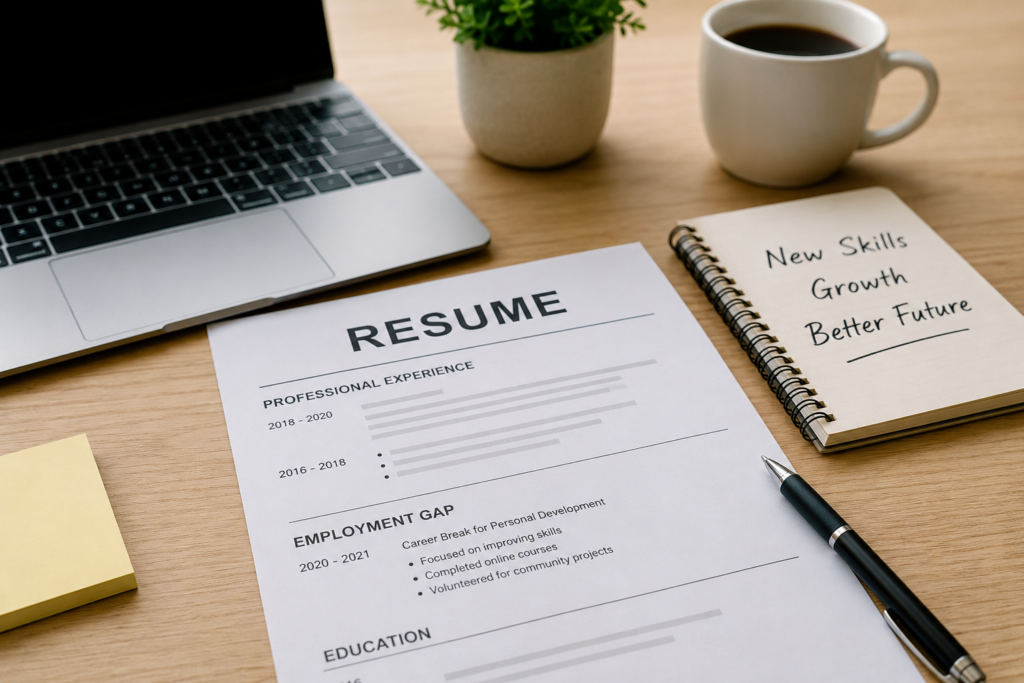
If you have a significant gap, you can add a short entry that explains how you spent that time.
For example:
Career Break
2021 to 2022
Focused on professional development, completed online training, and prepared to return to full time employment.
This approach is simple and professional. It also prevents the hiring manager from having to guess what happened during that period.
Explain What You Did During the Gap
One of the strongest ways to explain an employment gap is to focus on productive activities.
You may have completed courses, earned certifications, worked on freelance projects, volunteered, helped with a family business, learned new software, or developed skills independently.
These activities can demonstrate that you continued learning even when you were not employed.
For example, you could write:
Professional Development
2022 to 2023
Completed training in digital marketing, improved SEO knowledge, developed content writing skills, and worked on independent projects.
This type of explanation can turn an employment gap into evidence of personal and professional development.
Mention Freelance or Temporary Work
Sometimes people believe that only traditional employment belongs on a resume. I do not agree with that approach.
If you completed freelance projects, contract work, consulting assignments, or temporary jobs during your employment gap, include them when they are relevant to the position.
For example:
Freelance Content Writer
2022 to 2023
Created website content for small businesses, researched industry topics, and optimized articles for search engines.
This can be particularly helpful because it shows that you remained active professionally.
Even if the work was irregular, it may demonstrate valuable skills such as communication, organization, research, customer service, project management, or technical knowledge.
Address Education and Training
Education is another legitimate reason for an employment gap.
If you left your job to complete a degree, diploma, certification, or professional training, make that information visible on your resume.
For example:
Full Time Professional Training
2020 to 2021
Completed professional certification in project management while developing skills in planning, communication, budgeting, and team coordination.
This tells the employer that the period was intentional and connected to your professional development.
When possible, connect the training directly to the job you are applying for. This makes the explanation more relevant and valuable.
How to Explain a Career Break in an Interview
Your resume may explain the employment gap briefly, but an interviewer may ask you about it in more detail.
The best approach is to answer confidently and avoid becoming defensive.
For example:
“I took some time away from full time employment to focus on personal responsibilities. During that period, I also worked on improving my professional skills and completed several courses. I am now ready to return to a full time role and apply what I have learned.”
This answer is short, honest, and focused on the future.
You do not need to apologize for having an employment gap. A career break does not define your ability to perform a job.
Avoid Overexplaining Personal Matters
One mistake I often see is giving too much personal information when explaining an employment gap.
Your resume is a professional document. It does not need to contain private details about your family, finances, relationships, or personal circumstances.
You can keep your explanation general.
For example, instead of describing every detail of a difficult personal situation, you can write:
Career Break for Personal Responsibilities
2022 to 2023
Took time away from full time employment to manage personal responsibilities and prepare for the next stage of my career.
That is enough for most situations.
If an interviewer asks for more information, you can decide how much you are comfortable sharing.
Focus on Your Skills and Achievements
An employment gap becomes less important when the rest of your resume clearly demonstrates your value.
Focus on your professional skills, achievements, certifications, projects, and relevant experience.
For example, if you are applying for a marketing position, highlight skills such as SEO, content strategy, social media management, analytics, email marketing, and campaign planning.
If you are applying for an administrative position, emphasize organization, communication, scheduling, documentation, customer service, and computer skills.
The hiring manager wants to know whether you can perform the job. Your current abilities are often more important than a period when you were not employed.
Use a Skills Section Wisely
A strong skills section can help shift attention toward what you can offer.
Do not fill the section with random keywords just to make your resume look impressive. Instead, include skills that are relevant to the job description.
For example:
Professional Skills
Project Management
Customer Service
Microsoft Office
Data Analysis
Communication
Team Collaboration
Problem Solving
Digital Marketing
When your skills match the requirements of the position, the employment gap may become a much smaller part of the overall hiring decision.
What Not to Say About Employment Gaps
There are some approaches I would strongly avoid.
Do not lie about employment dates. Do not invent companies or projects. Do not blame previous employers for everything. Do not write a long emotional explanation on your resume.
Avoid phrases that make you sound ashamed, such as “Unfortunately, I was unemployed for two years.”
Instead, use professional language.
You can say:
Career Break
2021 to 2023
Focused on personal responsibilities and professional development before returning to the workforce.
The difference is small, but the second version sounds much more confident and professional.
How to Explain a Long Employment Gap
A long employment gap may require more attention, but it does not mean you cannot get hired.
If you have been away from work for several years, focus on what you have done recently to prepare for employment.
Update your skills. Complete relevant courses. Build projects. Volunteer when appropriate. Attend professional events. Refresh your resume and LinkedIn profile.
Then explain the gap honestly.
For example:
Career Break and Professional Development
2020 to 2024
Took an extended career break to manage personal responsibilities while completing professional training and maintaining industry knowledge. Now prepared to return to a full time professional role.
The most important part is showing that you are ready to work now.
Final Thoughts
In my view, an employment gap is only one part of your career story. It does not automatically make you a weaker candidate.
The best way to explain employment gaps on a resume is to be honest, keep the explanation professional, and focus on what you learned or accomplished during that time. Whether you were studying, caring for family, searching for work, freelancing, traveling, managing personal responsibilities, or developing new skills, you can present the experience in a positive and truthful way.
Remember that employers are looking for people who can solve problems, communicate effectively, learn quickly, and contribute to the organization. Your previous employment gap does not erase the skills and experience you have gained.
A good resume should tell a clear story. Your career does not have to look perfect. It simply needs to show where you have been, what you can do, and why you are prepared for the next opportunity.
If you approach your employment gap with honesty and confidence, you can turn a potentially uncomfortable question into an opportunity to demonstrate maturity, resilience, and professional growth.