
Related Articles



When exams are getting closer, one of the biggest mistakes I see students make is studying without a clear revision plan. They may spend several hours with their books open, but at the end of the day, they are not always sure what they have actually achieved. In my experience, having an effective revision plan makes studying more organized, less stressful, and much more productive.
A good revision plan does not mean studying every subject for many hours every day. It means knowing what you need to revise, deciding when you will revise it, and giving yourself enough time to practice and review what you have learned. When I create a revision plan, I try to keep it realistic because a complicated schedule is difficult to follow for a long time.
In this article, I will explain how to make an effective revision plan that can help you prepare for exams without feeling overwhelmed.
Understand What You Need to Revise
The first step in creating an effective revision plan is understanding exactly what you need to study. Before making a timetable, I recommend making a complete list of your subjects and topics.
Look at your syllabus, class notes, textbooks, assignments, and previous tests. Write down the topics you need to revise for each subject. This gives you a clear picture of the amount of work you have.
For example, if you are preparing for five subjects, you might divide them into smaller topics. Instead of writing Mathematics as one large task, you could write algebra, geometry, equations, graphs, and statistics.
Breaking subjects into smaller topics makes revision feel more manageable. It also helps you identify which areas require the most attention.
Set a Clear Revision Goal
A revision plan works better when you have a clear goal. Ask yourself what you want to achieve before the exam.
Your goal might be to understand every important topic, improve your weak subjects, complete past papers, or become confident with particular chapters.
I prefer setting smaller goals instead of thinking only about the final exam. For example, a useful daily goal could be to revise two chapters and complete twenty practice questions.
Small goals give you something specific to work toward. They also make it easier to measure your progress.
Find Out How Much Time You Have
Before creating your revision schedule, check how many days or weeks remain before your exam. Then consider how much time you can realistically study each day.
Do not assume that you will study for eight or ten hours every day if your normal routine does not allow it. A revision plan should match your actual lifestyle.
Think about school, college, work, family responsibilities, meals, sleep, exercise, and other important activities. Once you know how much free time you really have, you can create a schedule that is easier to follow.
In my opinion, consistency is more important than studying for extremely long hours once or twice.
Prioritize Difficult Subjects
Not every subject needs the same amount of revision time. Some topics may be easy for you, while others may require much more practice.
When making your revision plan, give additional time to subjects and topics that you find difficult.
For example, if you are comfortable with English but struggle with Mathematics, you may need to spend more revision time on Mathematics. This does not mean completely ignoring English. It simply means using your available time wisely.
You can also prioritize topics based on their importance in the exam. If a particular chapter contains many important concepts or frequently tested questions, make sure it receives enough attention.
Create a Simple Revision Timetable
Once you understand your subjects, goals, and available time, you can create your timetable.
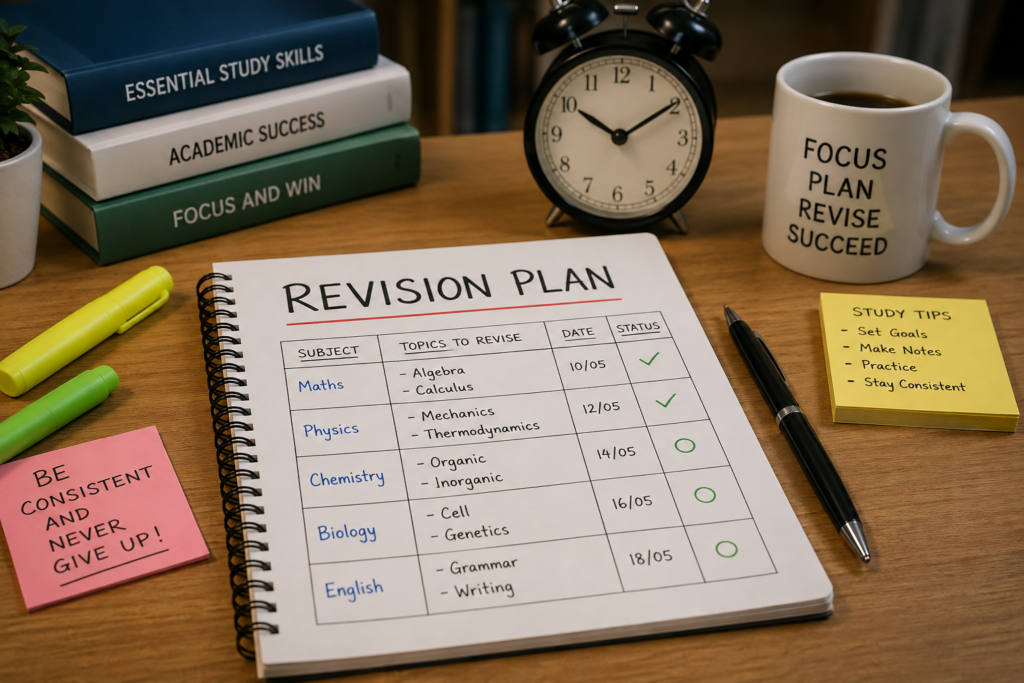
Keep your timetable simple. Write the date, study time, subject, and topic you plan to revise.
For example, a simple evening schedule could look like this:
4:00 PM to 5:00 PM Mathematics
5:00 PM to 5:30 PM Break
5:30 PM to 6:30 PM Biology
7:30 PM to 8:15 PM English
8:15 PM to 8:30 PM Quick review
This type of schedule gives you structure without making your entire day feel like an exam preparation session.
Divide Your Study Sessions
I find it much easier to concentrate when a large study session is divided into smaller periods.
Instead of sitting with one subject for several hours without a break, divide your revision into focused sessions. You could study for forty five minutes and then take a short break before starting again.
During each session, focus on one specific task. For example, you could spend one session learning a topic, another session answering questions, and another session reviewing mistakes.
Short focused sessions can help you maintain concentration and avoid mental exhaustion.
Use Active Revision Methods
An effective revision plan should not simply tell you when to study. It should also include how you will study.
Reading the same chapter repeatedly can feel productive, but active revision methods often help you engage more deeply with the material.
Try answering questions without looking at your notes. Create flashcards for important information. Explain a difficult concept in your own words. Practice diagrams, formulas, definitions, and examples.
Past papers are also extremely useful because they help you understand the type of questions you may face in an exam.
When I revise, I try to spend less time simply looking at information and more time testing whether I can remember and use it.
Include Regular Review Sessions
One of the most important parts of an effective revision plan is regular review.
After learning a topic, do not assume that you will remember everything until exam day. Plan short review sessions throughout your schedule.
For example, you might study a topic on Monday and review it again on Wednesday. You could then test yourself again the following week.
This approach helps you notice what you remember and what you have forgotten. It also prevents you from leaving all revision until the final few days.
Leave Time for Practice Questions
Revision is not complete until you test your knowledge.
Make space in your revision plan for practice questions, quizzes, exercises, and past papers. These activities can show you whether you actually understand a topic.
If you get a question wrong, do not simply move on. Find out why your answer was incorrect and review the relevant concept.
I believe mistakes can be extremely useful during revision because they show you exactly where more work is needed.
Plan Around Your Energy Levels
Everyone has different times of the day when they can concentrate best. Some students feel more focused in the morning, while others prefer studying in the afternoon or evening.
Try to schedule difficult subjects when your energy and concentration are highest.
For example, if Mathematics requires your full attention, you may want to study it when you feel fresh. Easier activities such as reviewing flashcards or organizing notes can be saved for a time when your energy is lower.
Understanding your own study habits can make your revision plan more effective.
Include Breaks and Rest
A revision plan should include rest. Studying continuously for hours without taking breaks can make concentration difficult.
Use short breaks between study sessions. During longer study periods, give yourself enough time to eat, relax, walk around, or do something that helps you refresh your mind.
Sleep is equally important. Staying awake all night to revise may seem like a good idea before an exam, but tiredness can make it harder to concentrate and remember information.
A balanced revision plan should protect your sleep and allow your brain enough time to recover.
Keep One Day for Catch Up
I strongly recommend leaving some flexible time in your revision schedule.
Sometimes a topic takes longer than expected. You may have an unexpected responsibility, become tired, or discover that you need more practice in a particular subject.
If every minute of your timetable is already planned, one missed session can make the entire schedule feel impossible to follow.
Keeping some flexible time allows you to catch up without creating unnecessary stress.
Track Your Progress
A revision plan becomes much more useful when you track what you have completed.
You can simply place a check mark beside each topic after revising it. You could also write a short note about how confident you feel with that topic.
For example, you might mark a topic as strong, needs review, or needs more practice.
This gives you a quick overview of your progress. It also helps you decide where to focus during your next study session.
Adjust Your Revision Plan
Your first revision plan does not have to be perfect.
After a few days, look at what is working and what is not. Maybe you planned too many topics in one evening. Perhaps you need longer breaks or more time for practice questions.
Do not be afraid to change your schedule.
An effective revision plan should support you rather than make you feel guilty. If something is unrealistic, adjust it and continue.
Avoid Making Your Schedule Too Complicated
One common mistake is creating a beautiful timetable with too many details but then struggling to follow it.
Your revision plan does not need to look perfect. It needs to be practical.
You can use a notebook, calendar, spreadsheet, or planning app. Choose whichever method you are most likely to use consistently.
The most important thing is knowing what you need to study and when you intend to study it.
Stay Consistent
Consistency is one of the most important parts of successful revision.
You do not need to have a perfect study day every day. Some days will be more productive than others. What matters is continuing with your plan and returning to your routine after a difficult day.
If you miss one study session, do not give up on the entire schedule. Look at what remains, adjust your plan if necessary, and start again.
Progress comes from repeated effort over time.
Final Thoughts
Learning how to make an effective revision plan can completely change the way you prepare for exams. Instead of opening your books without knowing where to start, you have a clear direction and a realistic goal.
From my point of view, the best revision plan is not the one that contains the most study hours. It is the one you can actually follow. Start by listing your subjects and topics, identify your weak areas, set realistic goals, divide your time into focused sessions, and include regular practice and review.
Do not forget to schedule breaks, protect your sleep, and leave some flexible time for unexpected problems. Most importantly, keep checking your progress and adjust your plan when necessary.
A good revision plan gives you more than a study schedule. It gives you confidence because you know what you have completed and what still needs attention. With a clear plan and consistent effort, revision can become much more organized and less stressful.